
The Seven Outcasts · An atlas
TheWorld
Where the Outcasts live, train, argue and build: a mirror of our Earth, and a shipyard that never lands, flying a slow loop round the Moon.
世界
The atlas軌道図
Not to scale. The Earth on the left, the Moon on the right, and the long, thin loop the yards fly round it. Press a number to go there.

The mirror Earth
Our own Earth, one fork away: the same physics, the same history, the same documents, except that the samurai never ended. Their orders are known to everyone. They stay out of politics, and near a hull, where a missed shot goes through an oxygen line, guns are banned and blades rule.
From the yard it is a small blue disc. Hotaru calls down every week, and waits for the answer.
- 距離From the yard
- A light-second and a quarter
- 往復Radio, there and back
- Two and a half seconds
- 登場Seen
- Through every window
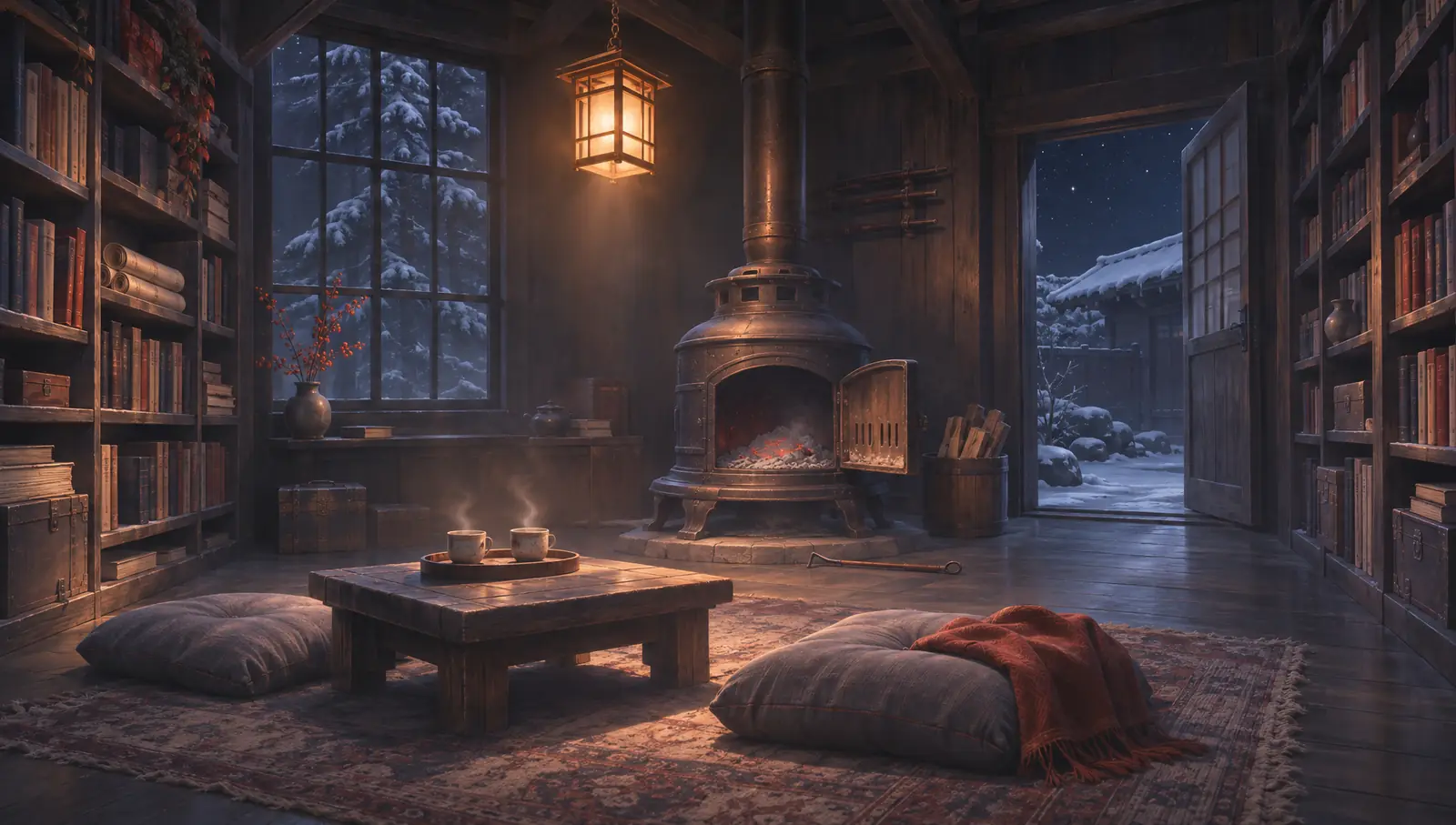
The cabin
Books to the ceiling and a cast-iron stove. It is Grand Pa's fire, left for the night, and Rei has been poking it since one when Itsuki comes in with two cups of tea.
Outside: a street, a scooter, roofs, and the stars above them. Where the house stands, nobody says.
- 登場Seen in
- Talk 02 · Curfew
- 人物Who
- Rei and Itsuki
- 火Whose fire
- Grand Pa's
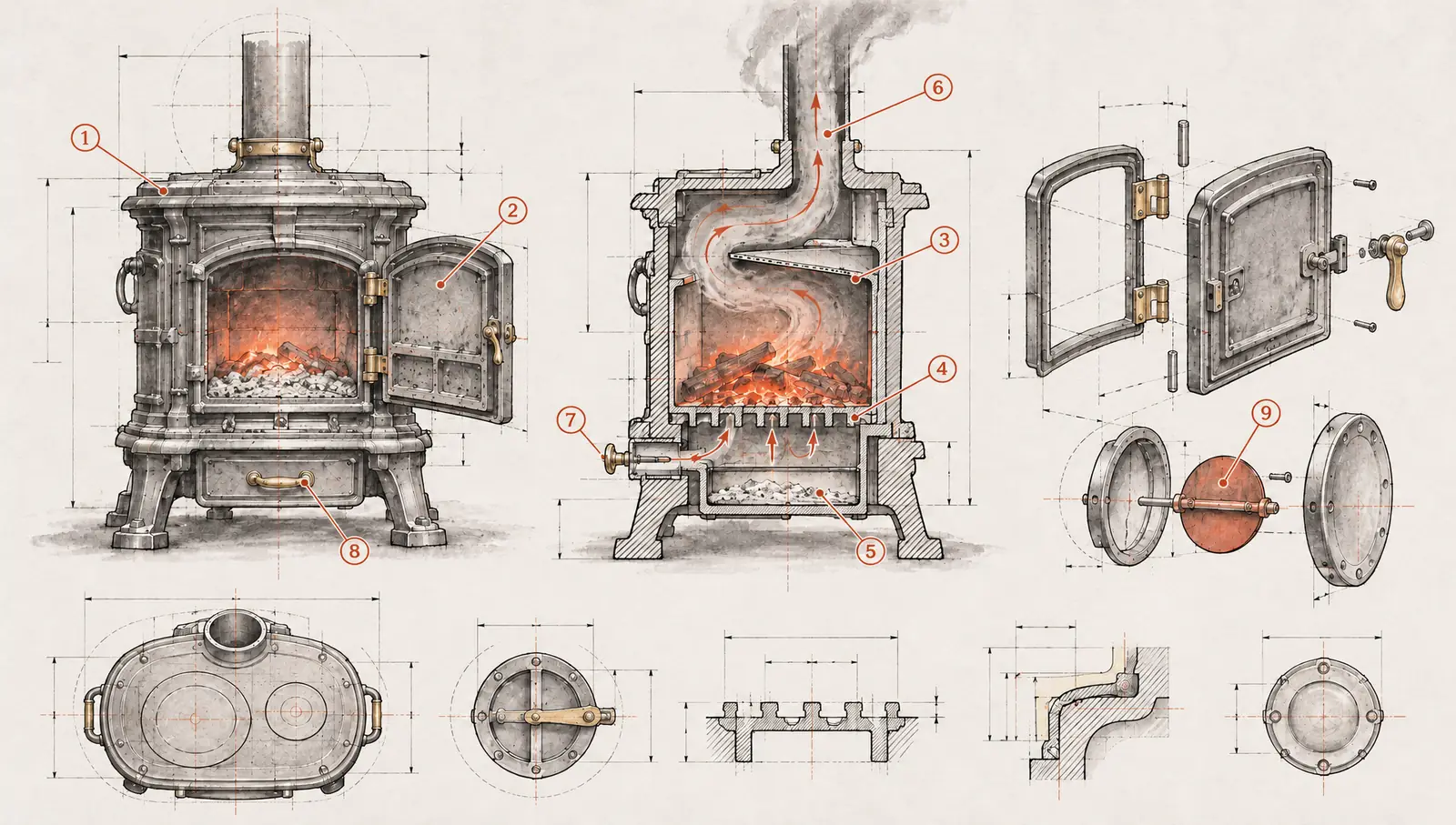 Plate · Grand Pa's stove →
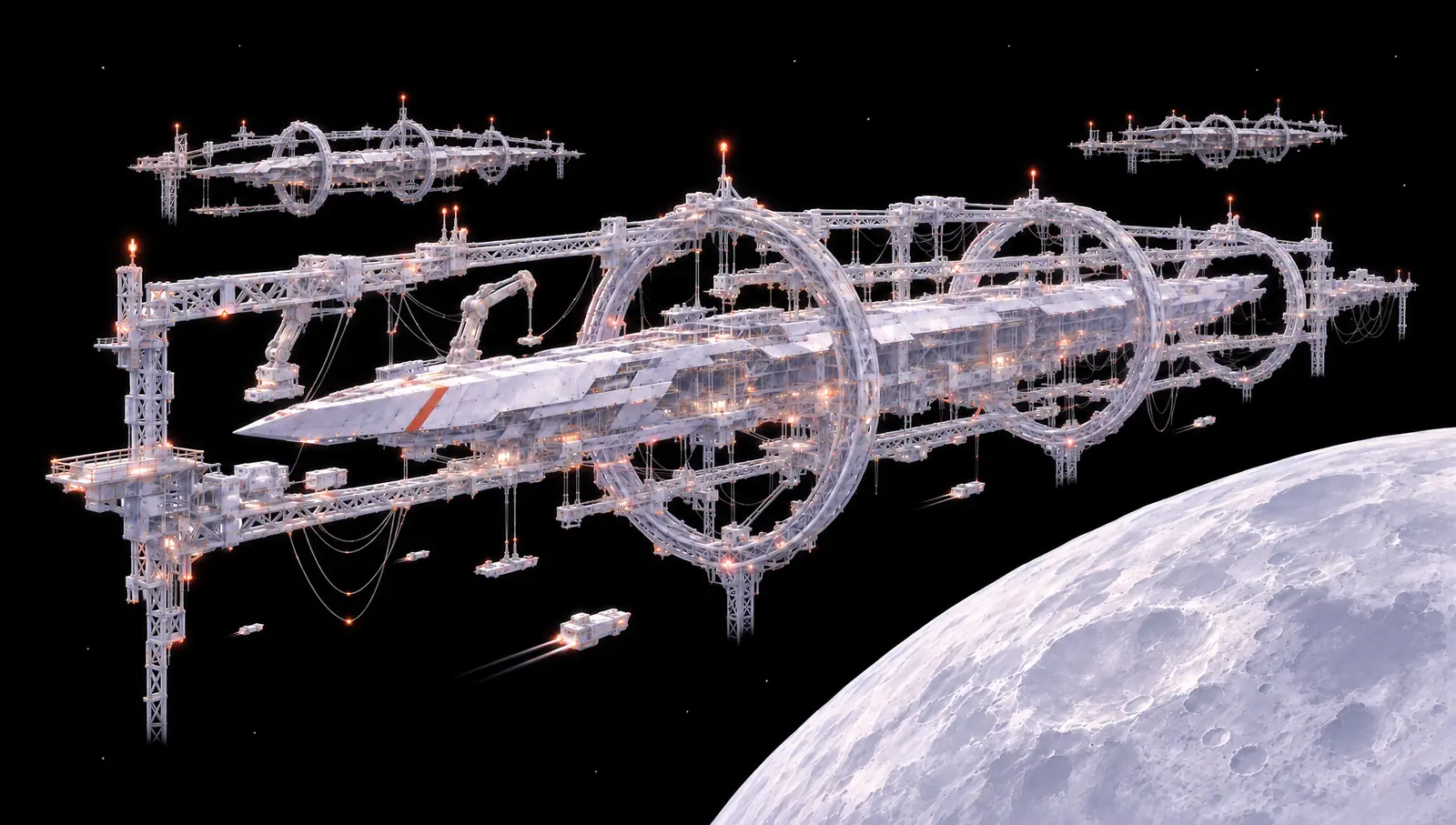
The yards
Ships for the stars are built up here, because leaving the Earth for good takes eleven kilometres a second, and leaving the Moon under two and a half. Some yards are known, owned by consortiums. Others are steeped in mystery and misdirection. They build ships for the stars, and warships too.
One of them belongs to the Outcasts, the only ones known to run their own. Hotaru is chief engineer. Grand Pa's word is law.
- 軌道Orbit
- Halo · low over the north pole, far out over the south
- 周期One lap
- ≈ 6.5 days
- 軌道維持To hold it
- One nudge a lap, a couple of millimetres a second
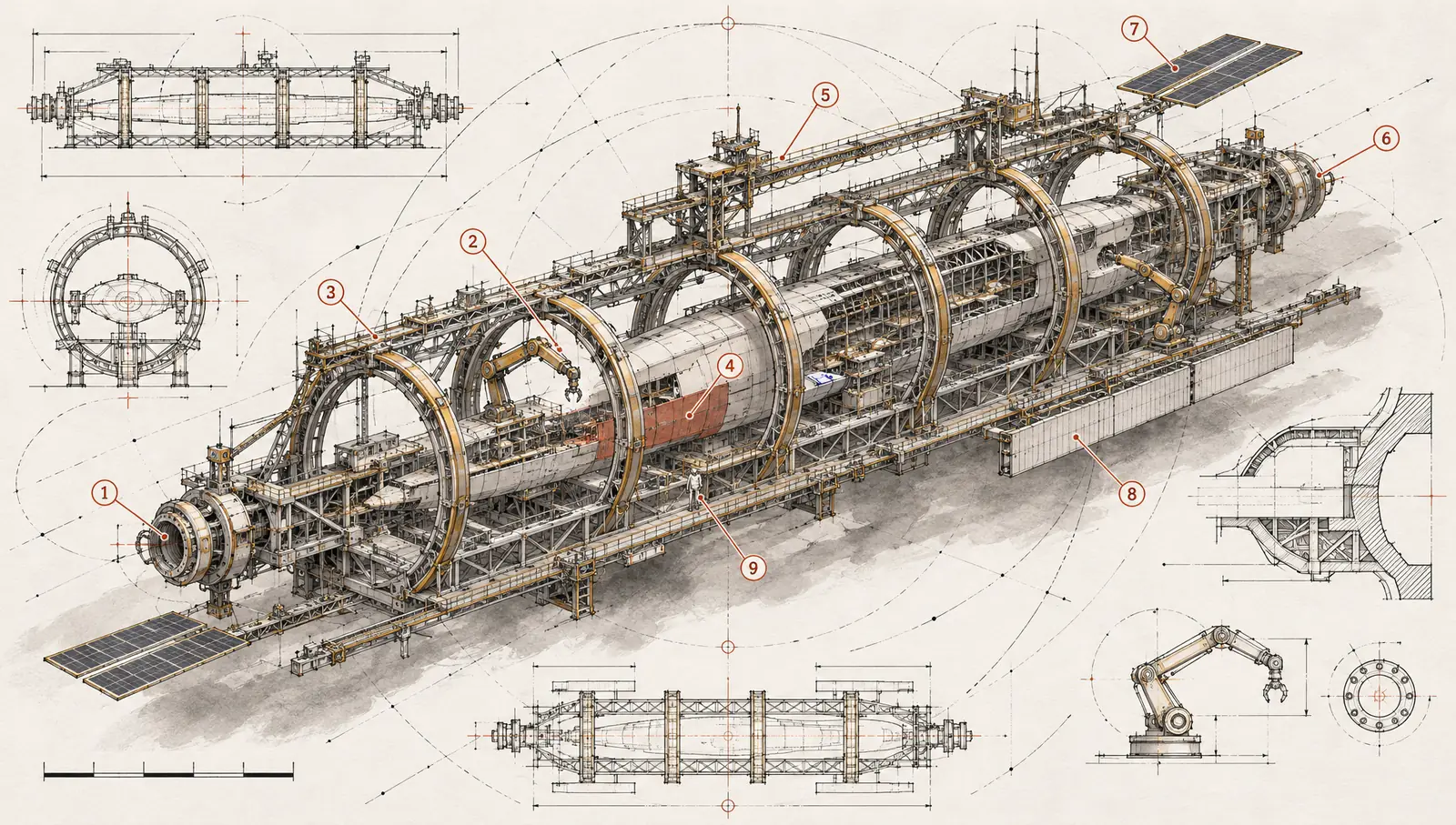 Plate · The yard frame →
The Moon port
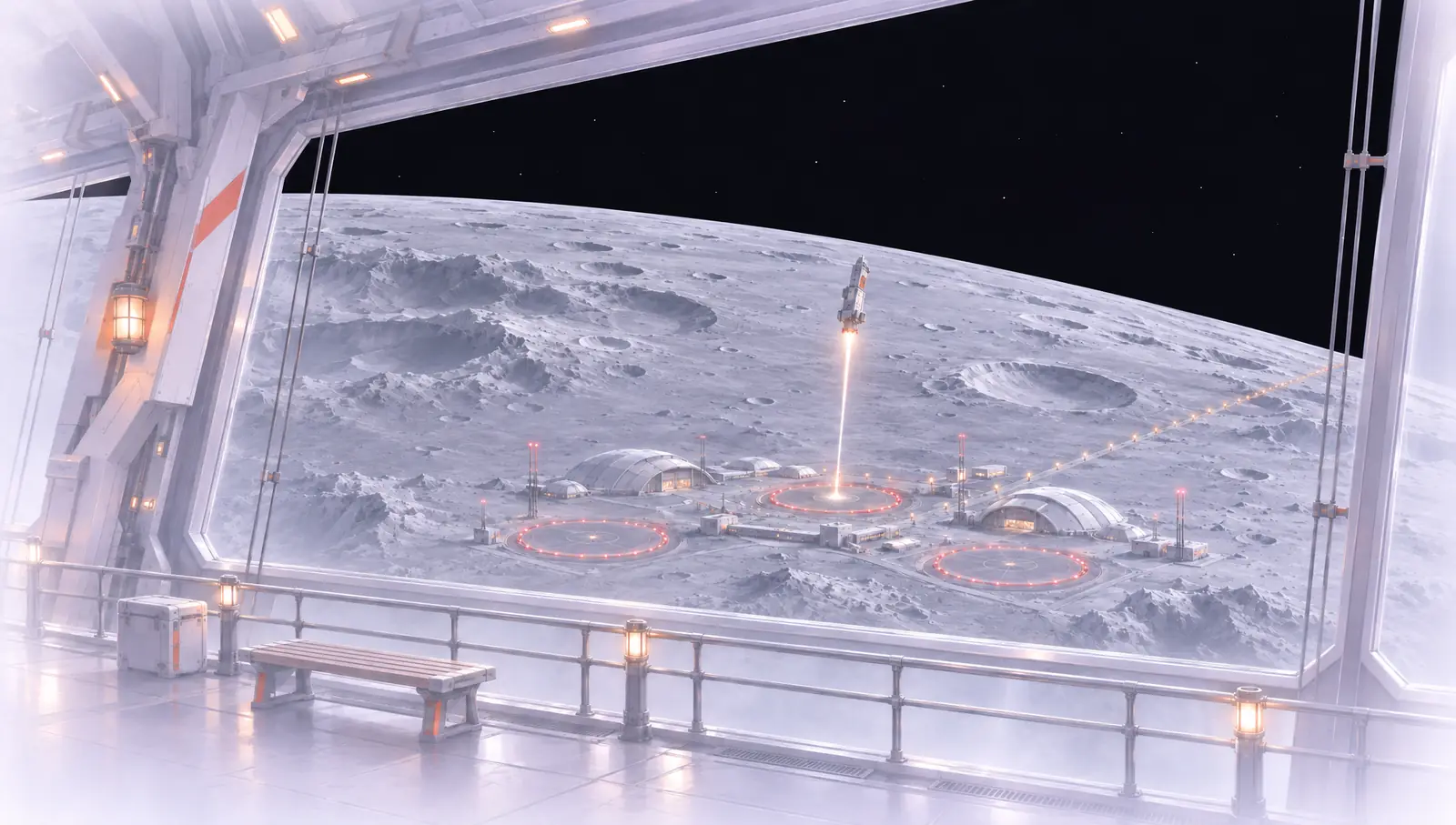
From the yard's launch deck you watch cargo ships lift off the Moon on a thin, straight flame. No smoke and no clouds: there is no air to make them.
Below, three pads of fused grey soil, beacons in a long straight line, and sheds buried under the regolith against the radiation.
- 脱出速度To leave the Earth
- 11.2 km a second
- 脱出速度To leave the Moon
- 2.4 km a second
- 登場Seen in
- Short 26
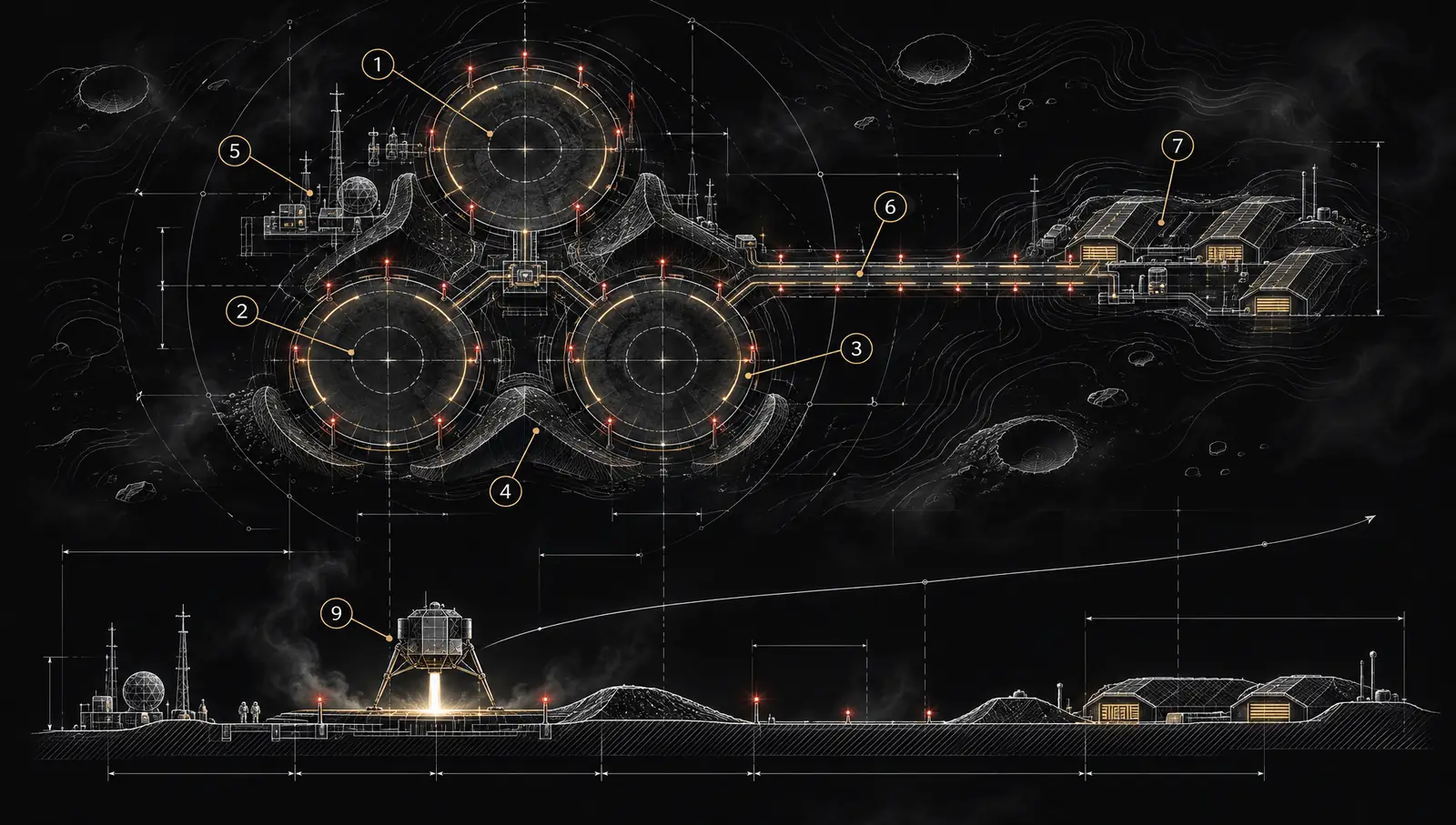 Plate · The Moon port →
The training deck
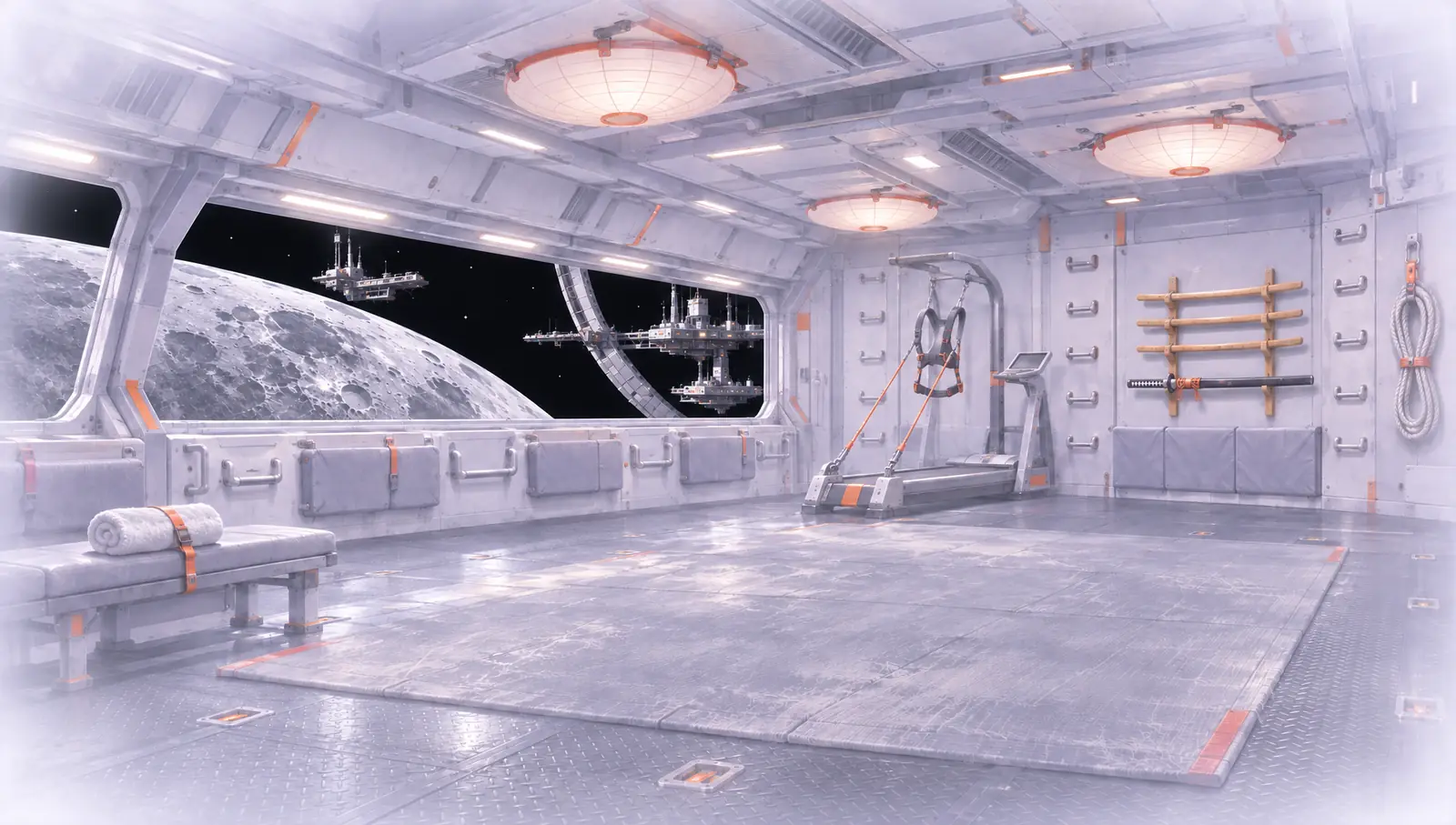
The Outcasts' training ground: a worn mat, a sword rack, and a long window onto the Moon.
Up here even a tug of war goes strange: with no floor to push on, two people pulling a rope just drift towards each other. Rei teaches the others to fall, and Itsuki runs on a treadmill whose harness pulls him down onto the belt, because bone that carries no load wastes away.
- 登場Seen in
- Shorts 05, 06, 12 and 21
- 人物Who
- Rei, Hotaru and Itsuki
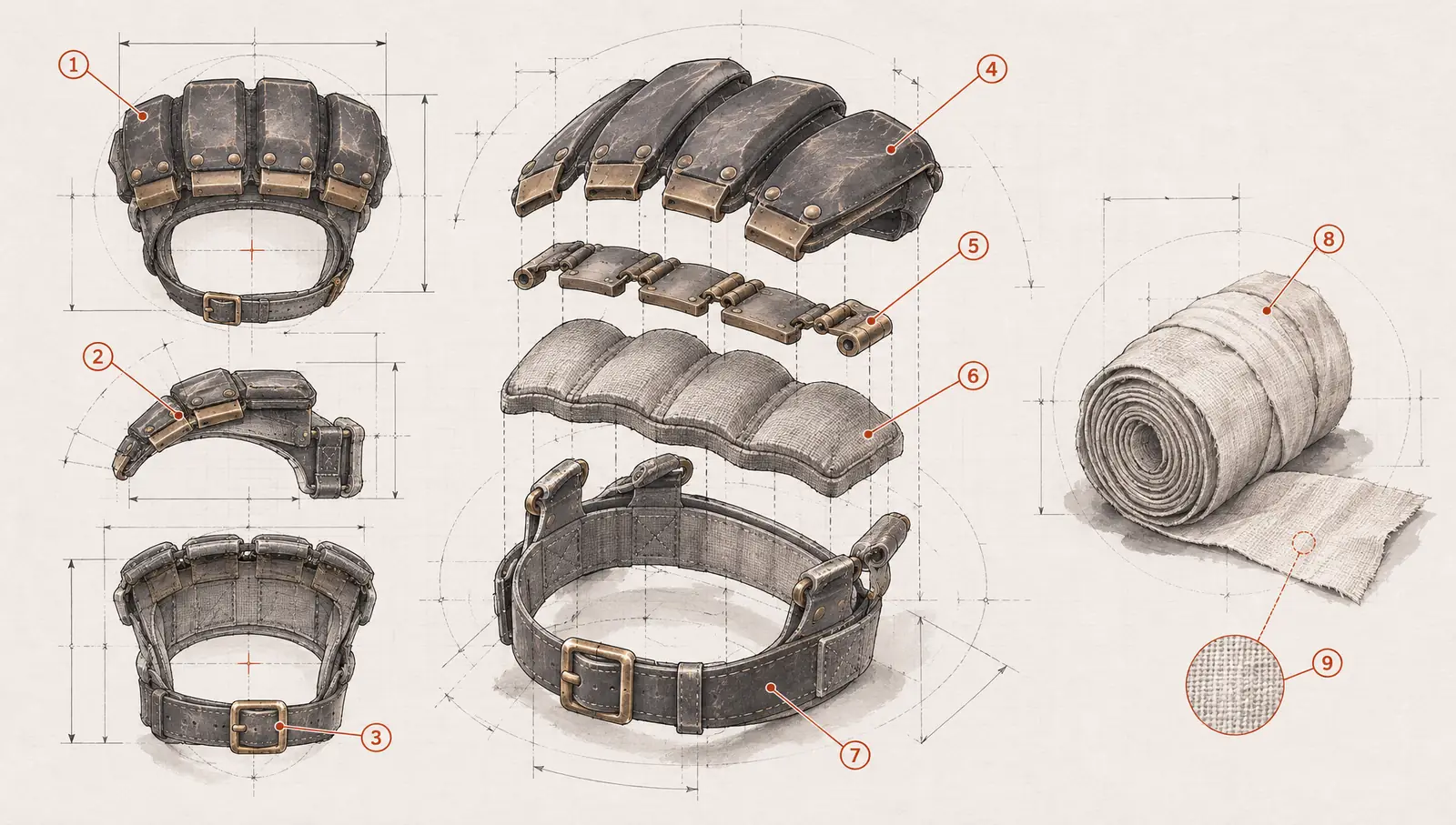 Plate · Rei's hand guards →
The workshop
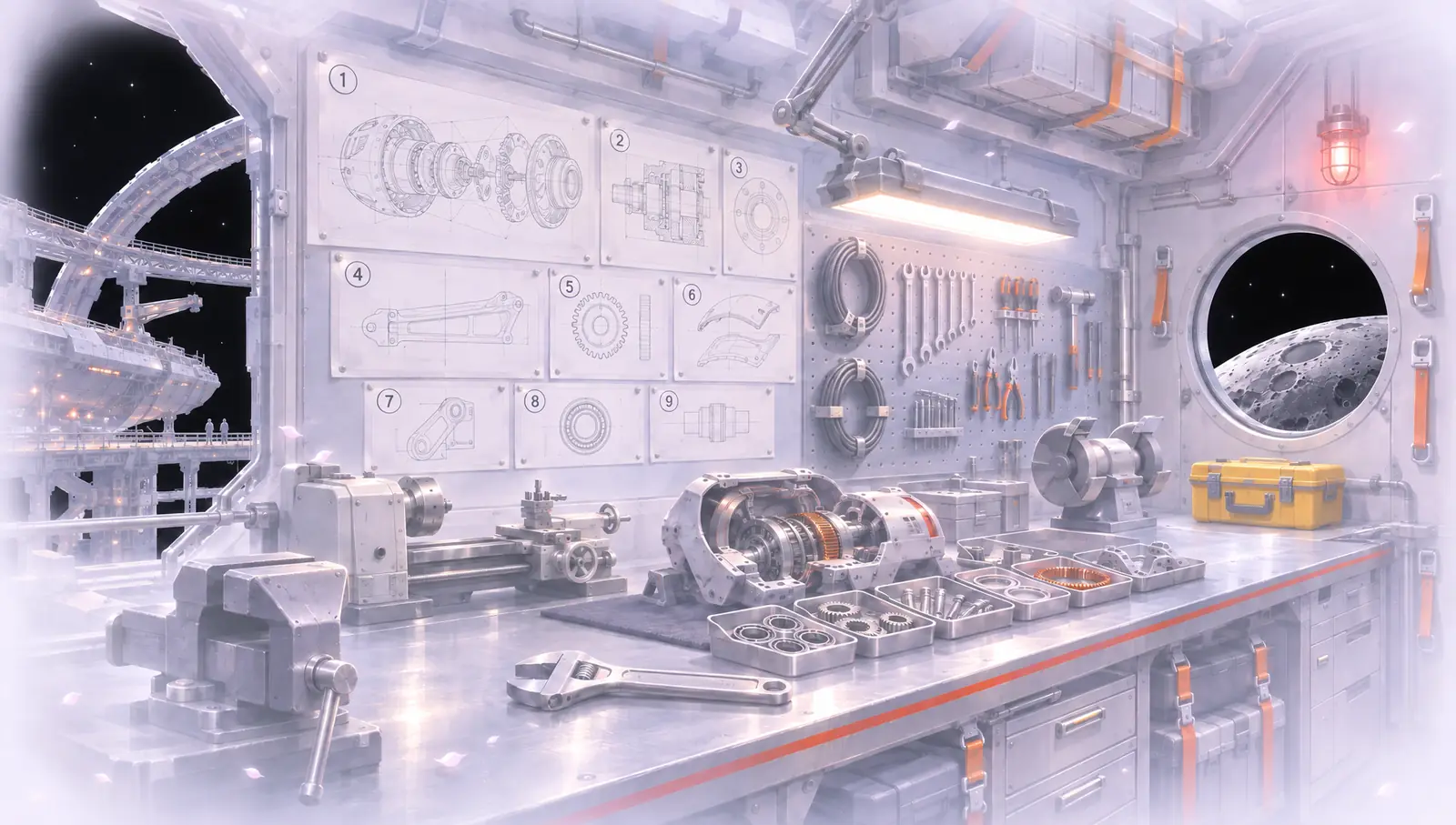
Two in the morning, a steel bench, a bolt sliding to a stop. This is where things are taken apart to find out what's true.
Hotaru's rule: a broken engine tells the truth. A speech doesn't.
- 登場Seen in
- Shorts 01, 14, 15, 25 and 29
- 人物Who
- Hotaru, with Itsuki or Rei
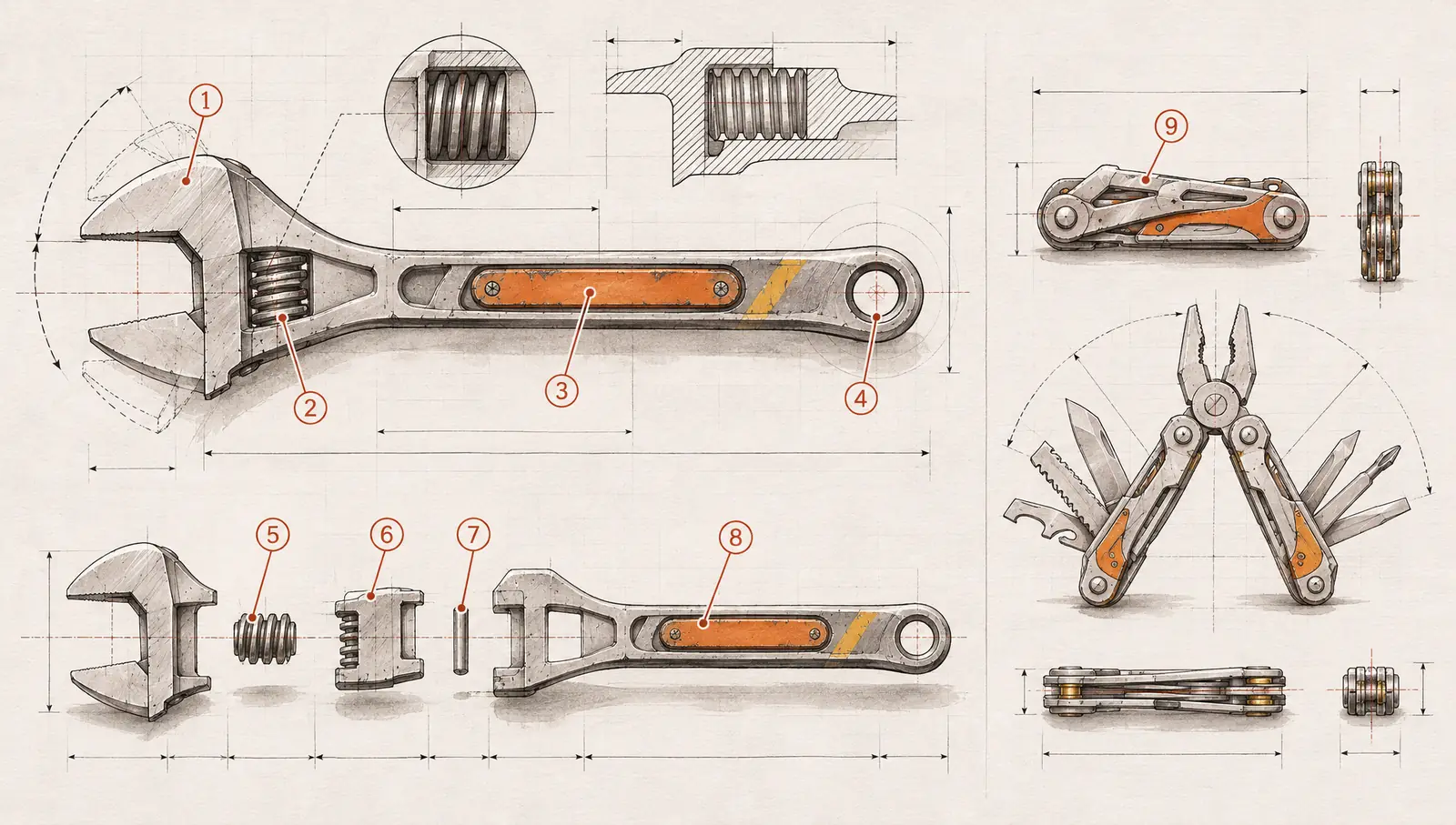 Plate · Hotaru's spanner →
The navigation room
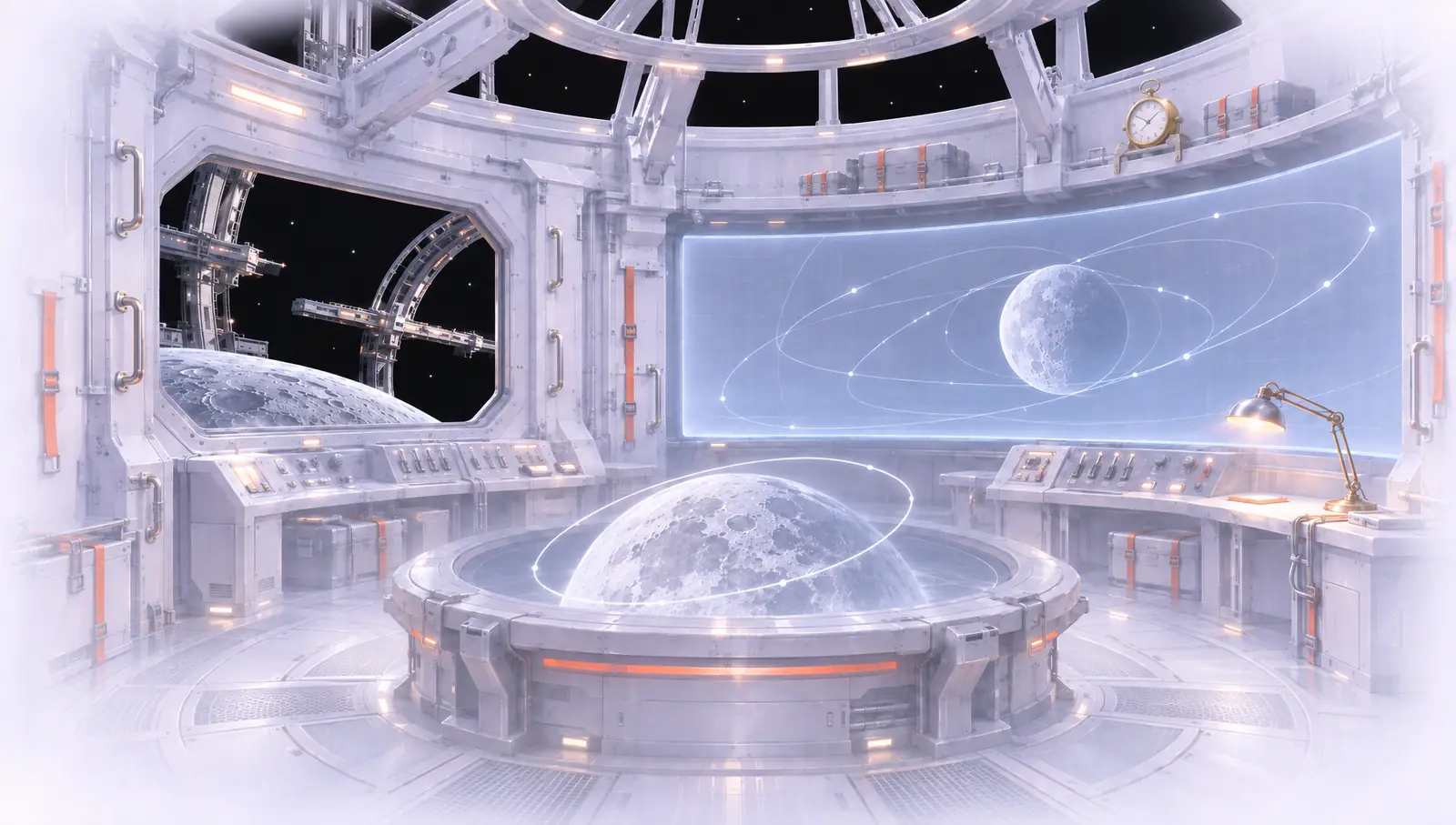
Low orbits round the Moon don't last. Its gravity is lumpy, and on the globe table a low orbit sinks lap by lap toward a dark lunar sea.
So the yard flies the halo: in low over one pole, far out over the other, six and a half days a lap.
- 登場Seen in
- Shorts 09, 11 and 17
- 人物Who
- Itsuki and Hotaru
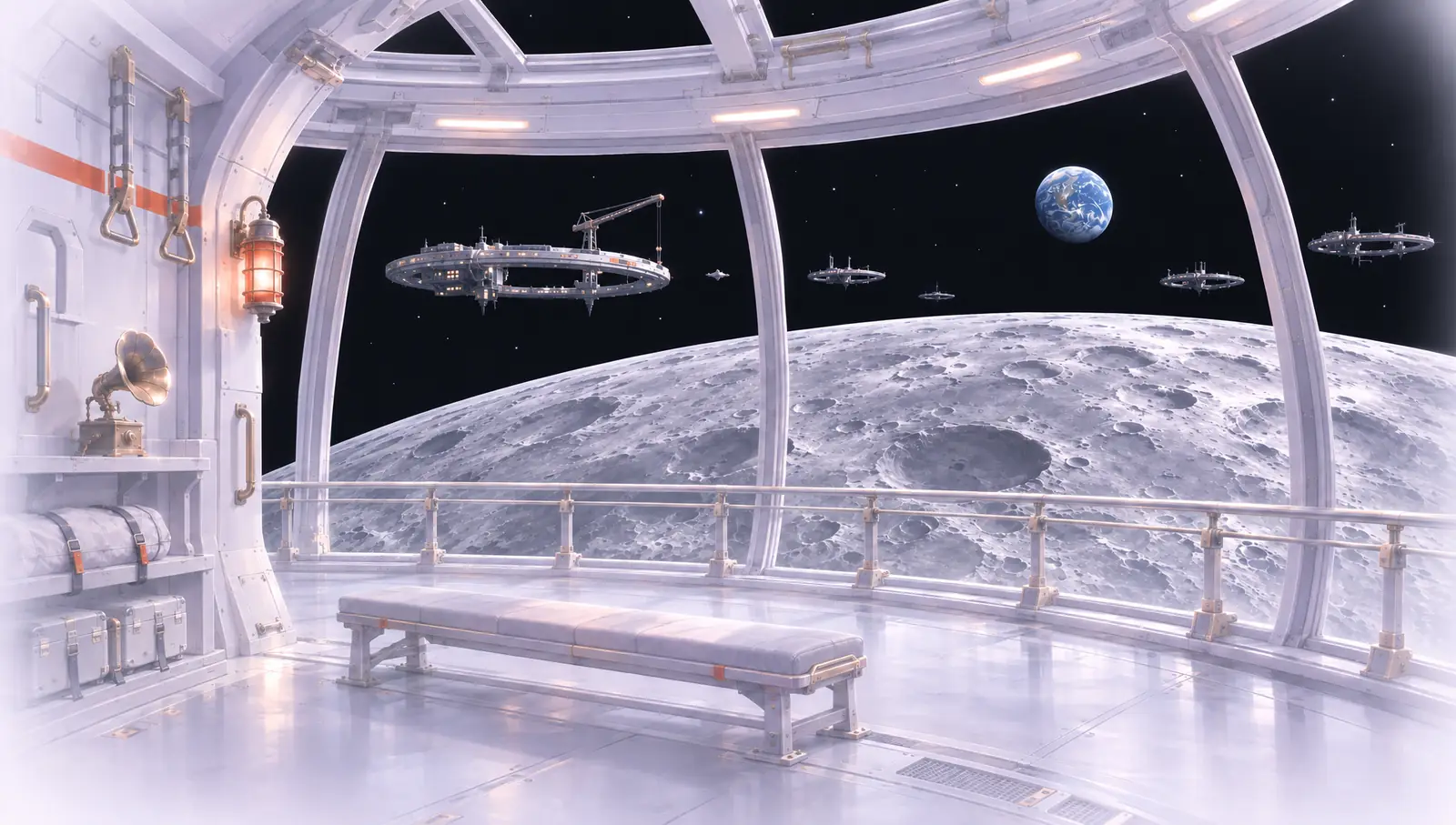
The observation deck
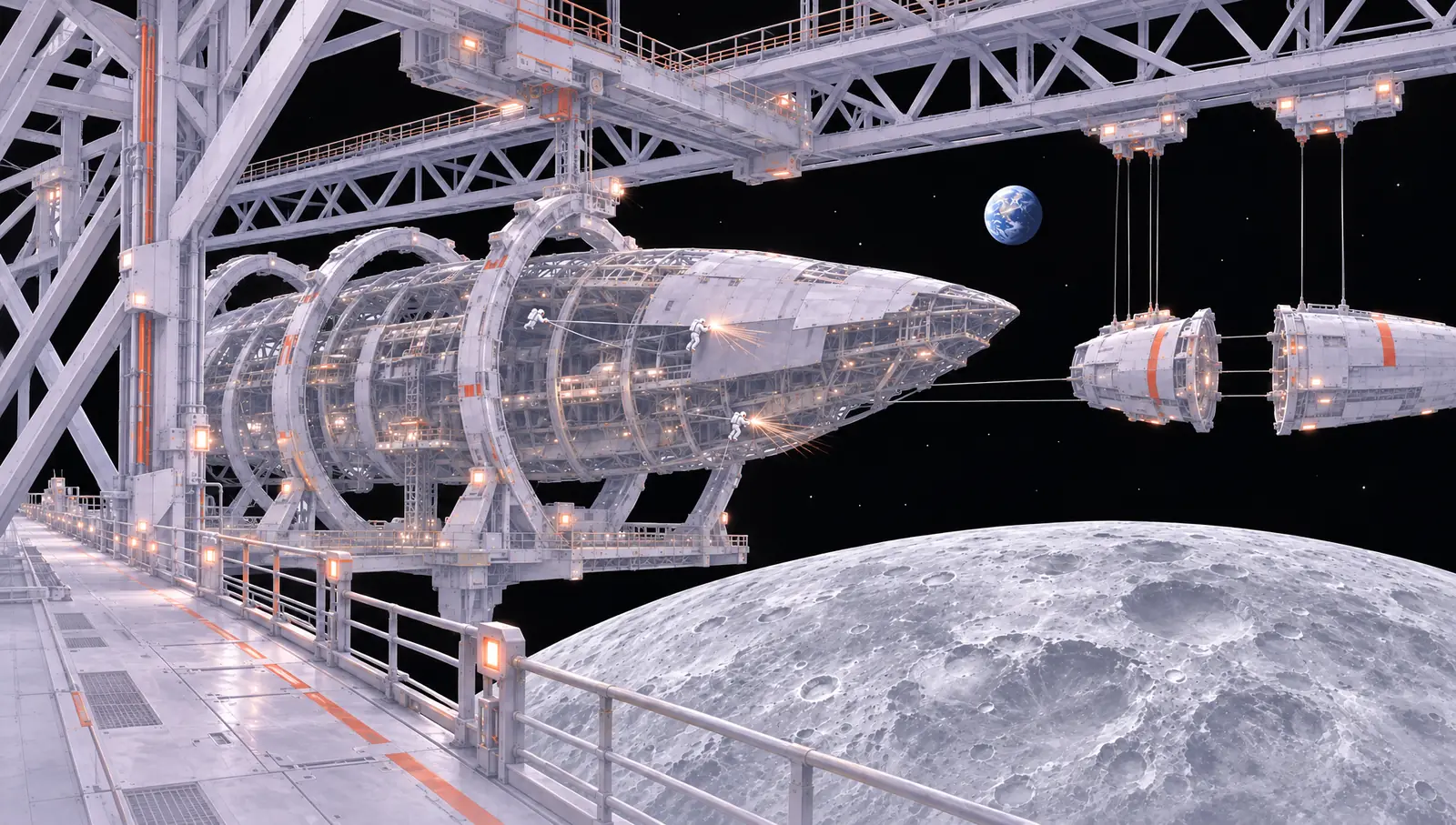
Welders drift along the hull outside, their sparks flying in perfectly straight lines. The Earth hangs small and blue beyond the Moon's grey edge.
Nothing up here floats. Everything is falling round the Moon together, the yard, the people and the tea.
- 登場Seen in
- Shorts 10, 13, 18, 22 and 23
- 人物Who
- Itsuki, Rei and Hotaru
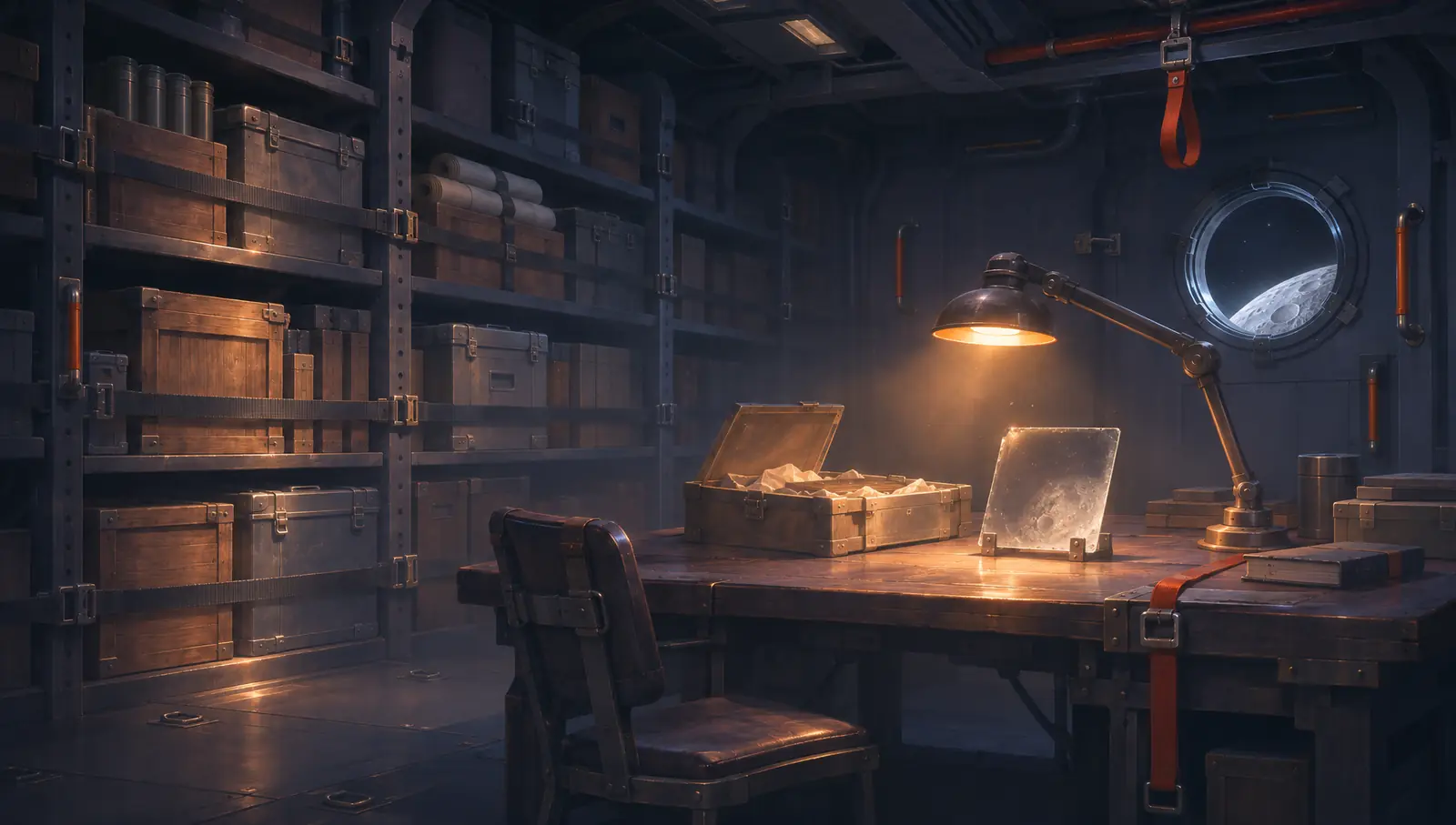
The archive
Shelves of crates, one lamp, the night shift. Rei brings in a copy of an old glass eclipse plate and asks who proved Einstein right.
The answer was in the crates all along: the plates they set aside, checked by a stranger sixty years later.
- 登場Seen in
- Talk 03 · Who Gets to Be Right
- 人物Who
- Rei and Itsuki
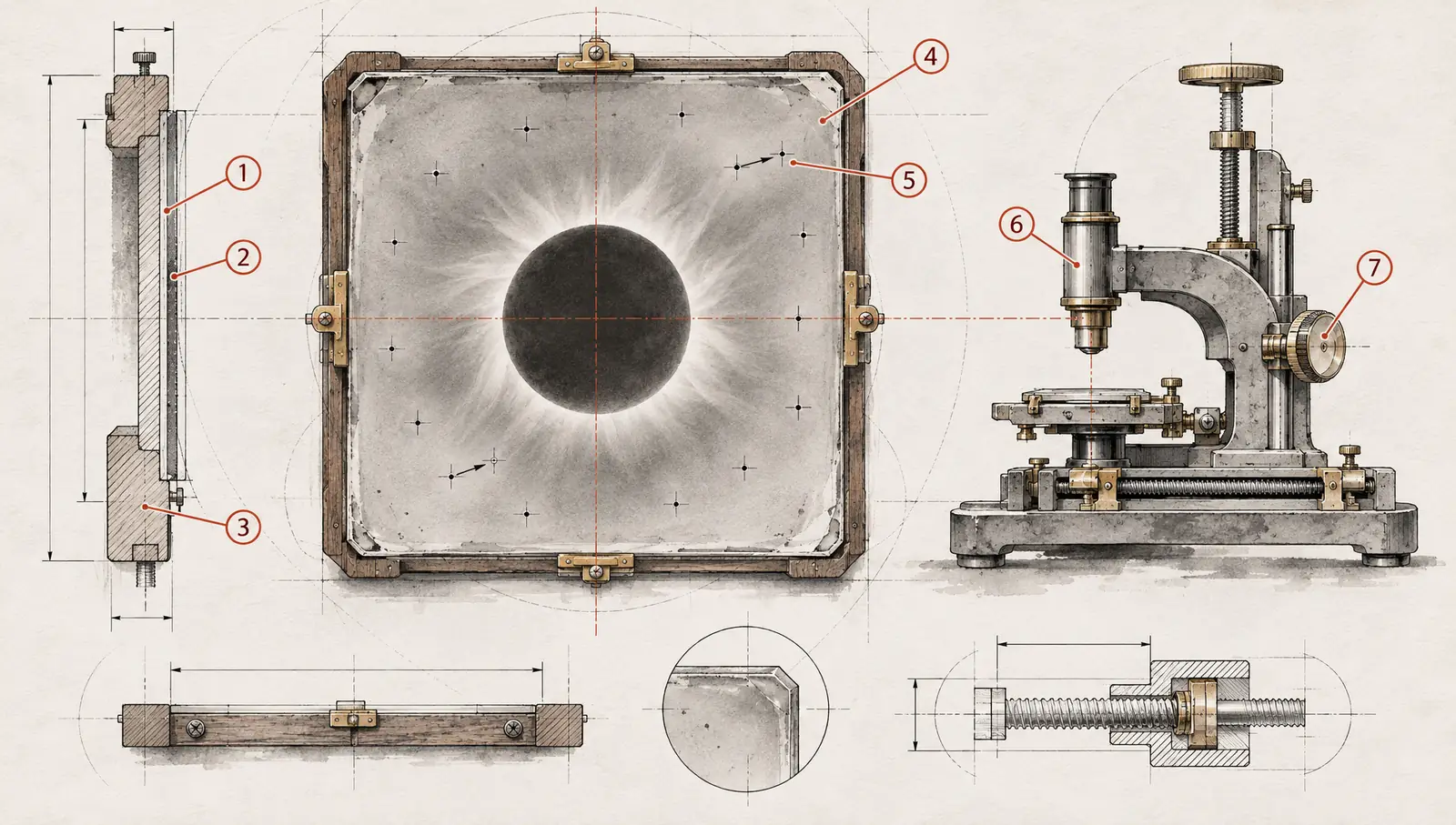 Plate · The eclipse plate →
The plates設計図
Everything the Outcasts carry or build, drawn the way their engineers draw it. Drag along, open a sheet for its key.
Drag or swipe9 sheets
設計図 · PlateItsuki's katana
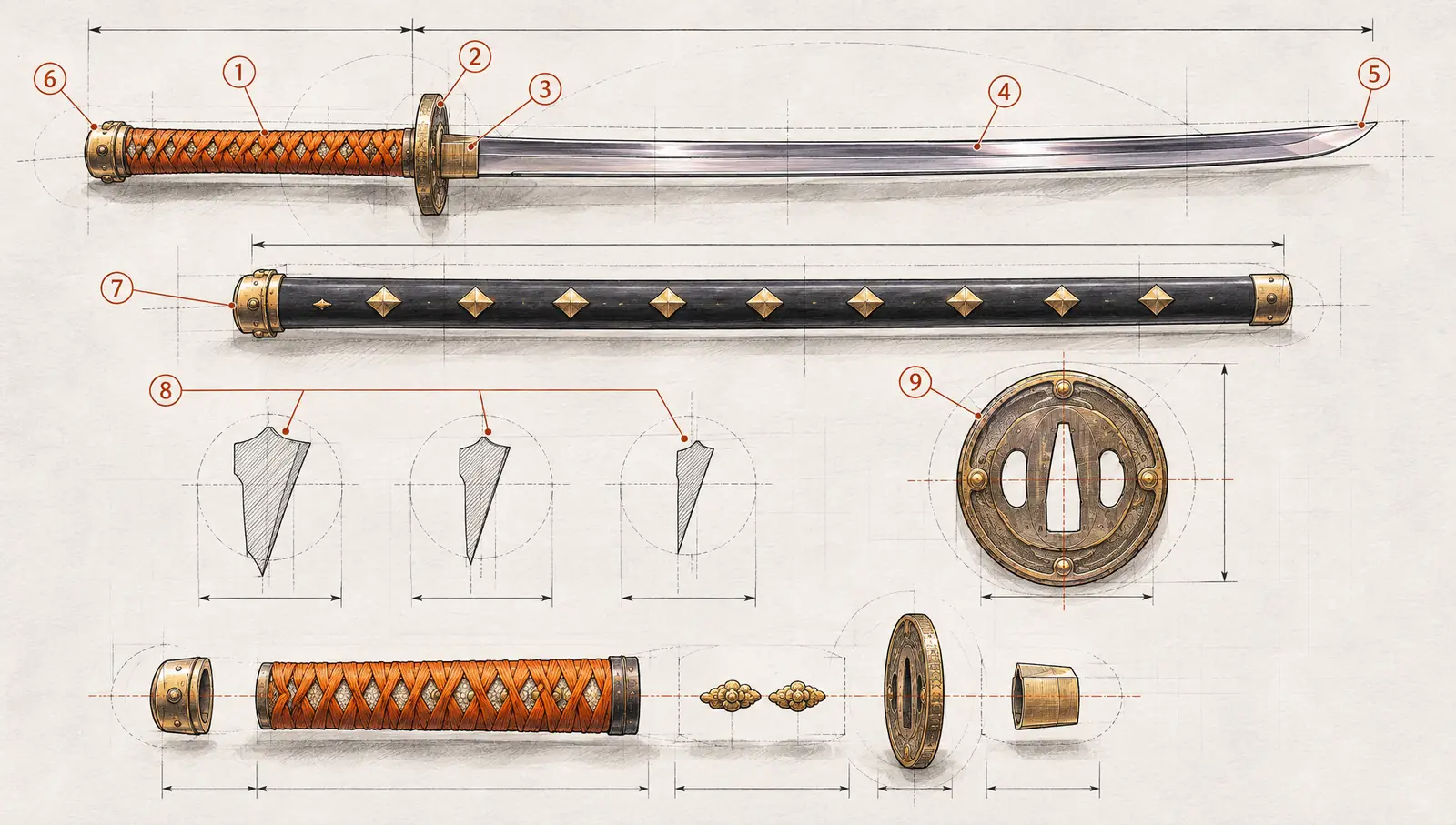
刀 · 天馬 樹
His one sword, carried across his back, hilt over the left shoulder. Orange braid on the grip, small gold diamonds on a black scabbard.
- Grip柄 Wrapped in orange braid over ray skin, in a diamond pattern.
- Guard鍔 A round guard in worn brass.
- Collar鎺 Locks the blade in the scabbard's mouth.
- Blade刀身 One edge, a gentle curve.
- Tip切先 Where the curve meets the point.
- Pommel cap頭 Closes the end of the grip.
- Scabbard mouth鯉口 Black lacquer with gold diamonds along the scabbard.
- Blade sections断面 Cut near the hilt, the middle and the tip.
- Guard, face on鍔 The opening for the blade and the two side holes.
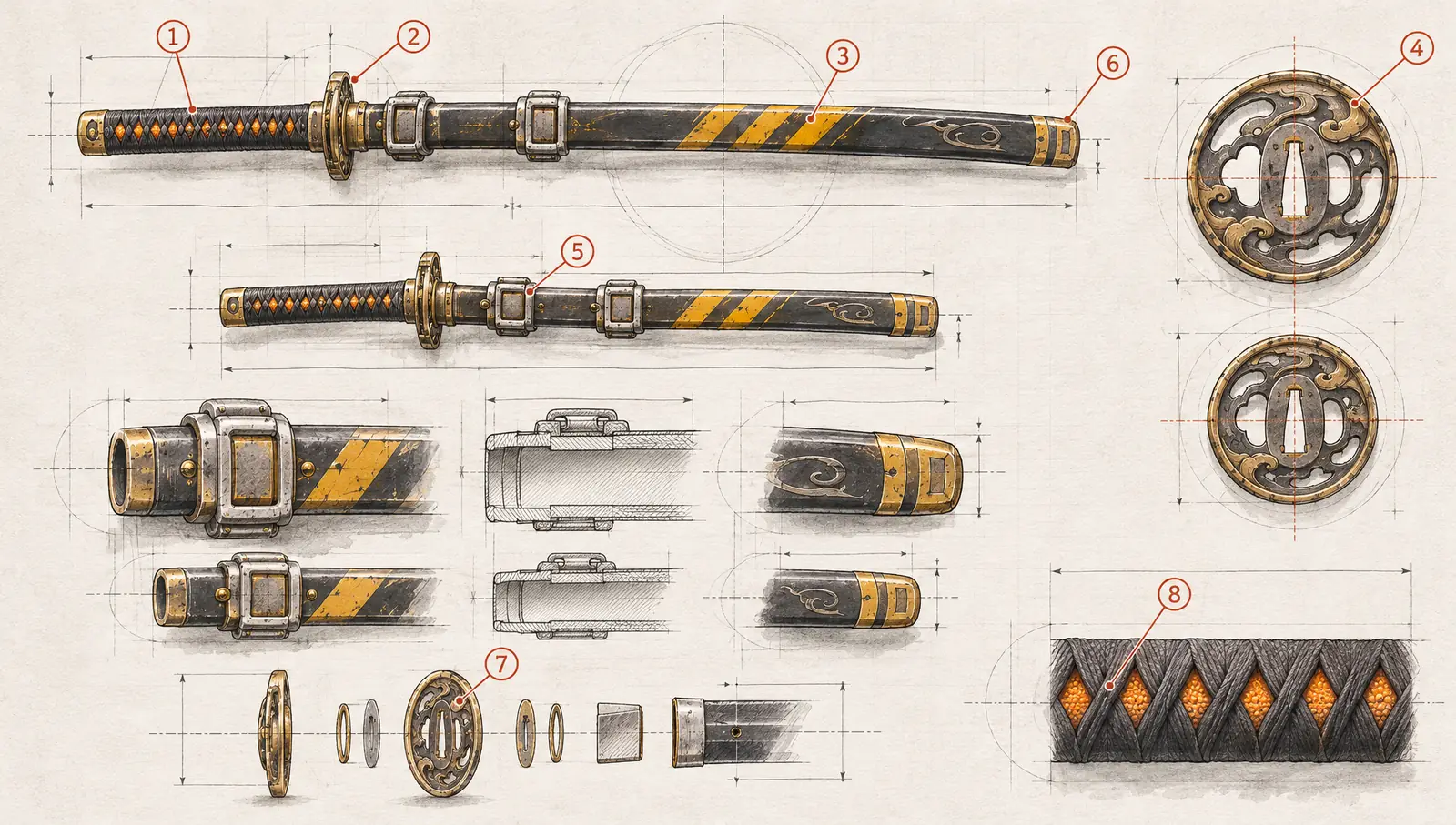
Hotaru's two swords
大小 · 黒鉄 蛍
A long sword and a short one, worn on her back, hilts over her right shoulder. Hazard stripes on the scabbards, because she builds near hulls.
- Grip柄 Dark cord over orange, in diamonds.
- Guard鍔 Pierced brass and iron.
- Hazard stripes警戒色 Yellow and black, on both scabbards.
- Guard, face on鍔 Cloud pattern, cut through.
- Harness band帯金具 Holds the pair on her back harness.
- End cap鐺 Brass, banded.
- Guard fittings鍔周り Washers, guard and collar in order.
- Grip wrap柄巻 The cord pattern, close.
Hotaru's spanner
スパナ · 黒鉄 蛍
Her signature tool, usually on her shoulder. An adjustable spanner and a multitool, both taken apart, because that is how she knows them.
- Fixed jaw固定顎 Forged in one piece with the handle.
- Worm screwウォームねじ Turn it to open or close the jaw.
- Grip握り Orange inlay, one hazard stripe.
- Hanging hole吊り穴 For a lanyard: in microgravity tools float away.
- Wormウォーム The screw, out of its housing.
- Sliding jaw可動顎 Runs along the slot.
- Pinピン Holds the worm in place.
- Handle柄 The body, with the jaw slot.
- Multitoolマルチツール Folded, then opened like a fan.
Rei's hand guards
手甲 · 雨宮 怜
Rei carries no sword. She fights close, for survival, not sport, with guards over linen wraps and fingerless gloves.
- Knuckle shells拳当て Four padded shells, one per knuckle.
- Hinge蝶番 Lets the hand close into a fist.
- Buckle留め具 Tarnished bronze, like her rings.
- Outer shells外殻 Hard on the outside.
- Hinge spine連結部 Links the shells together.
- Padding緩衝材 Thick, to protect her own hand.
- Strapベルト Round the palm and the wrist.
- Linen wrap布巻き Wound round the hand first.
- Weave織り The linen, close.
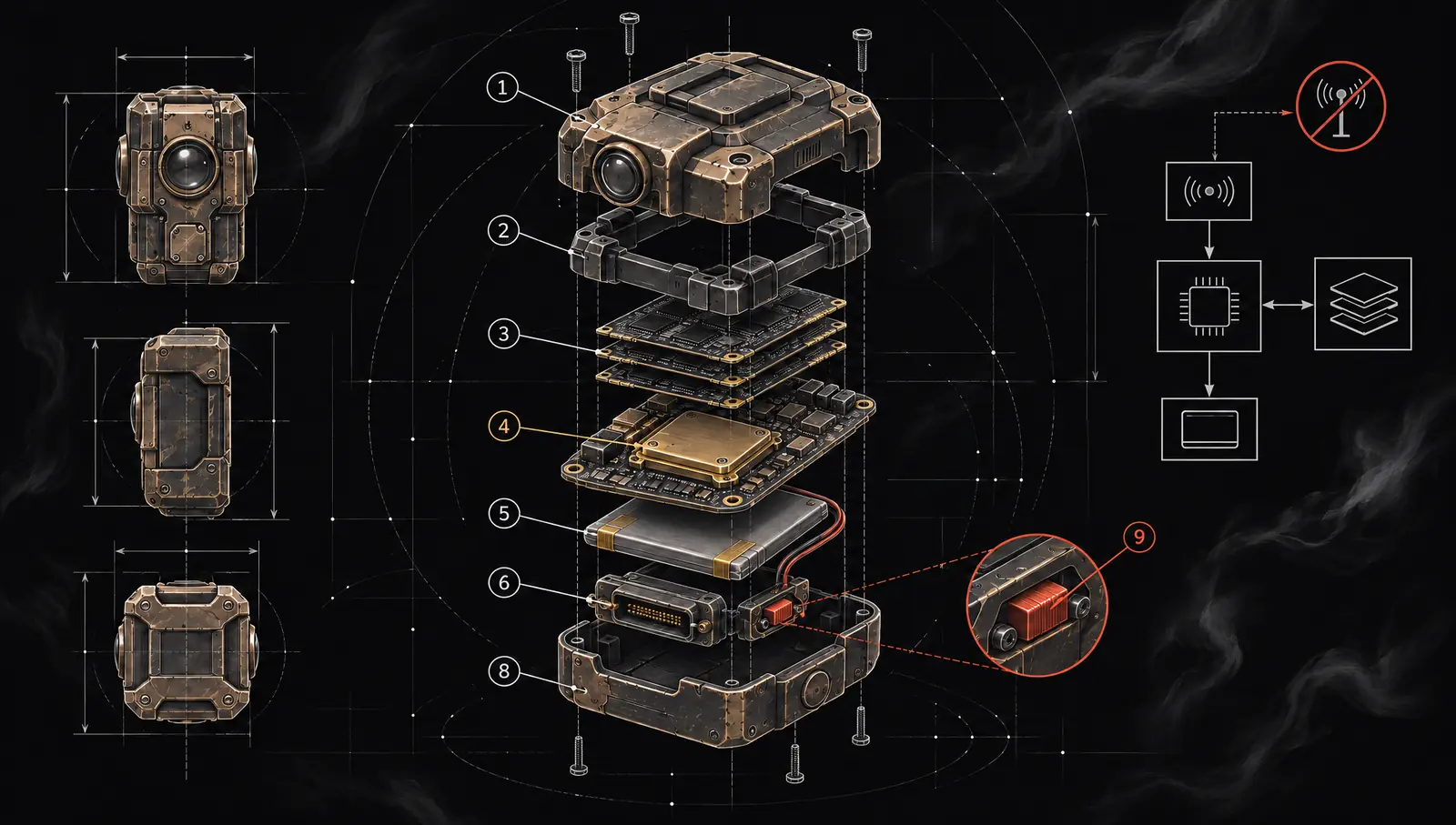
Rei's offline AI module
オフラインAI · 雨宮 怜
A palm-sized computer that runs a language model with no network at all. "It never says I don't know," she says. "Ask it anything, it answers in the same calm voice, right or wrong."
- Armoured shell外装 Scuffed, with a small lens.
- Shock frame防振枠 Survives a fall, or a fight.
- Memoryメモリ The model lives here, offline.
- Processor演算装置 Under a heat spreader.
- Battery電池 Days, not hours.
- Connector接続端子 Sealed against dust.
- —
- Base底部 The other half of the shell.
- Kill switch遮断スイッチ A physical switch that cuts it off. Her rule.
The yard frame
造船架台
The Outcasts' yard as its engineers draw it: an open frame of trusses round a hull, five great rings for a cradle, power from the Sun and radiators for the heat.
- Forward dock前方ドック Where tugs and crew craft berth.
- Robot armロボットアーム Lifts plates into place.
- Gantryガントリー The walkways the welders clip onto.
- Open plating外板 The part of the hull still being closed.
- Crane railクレーンレール Runs the full length of the frame.
- Aft dock後方ドック The other way in.
- Solar array太陽電池 Power for the whole yard.
- Radiators放熱板 In vacuum, heat can only leave as light.
- Scale縮尺 One person in a pressure suit.
The eclipse plate
日食乾板
A copy of an old glass photograph of the Sun gone dark, from the archive. Measure where the stars sit, compare them with the night sky, and you see the Sun's gravity bend their light.
- Glassガラス The plate itself.
- Emulsion感光乳剤 The thin layer that held the picture.
- Holder乾板枠 Wood and brass.
- Edge縁 Chipped, like the real ones.
- A shifted star星の偏位 Pushed outward from the Sun by a hair; the arrow shows which way.
- Microscope顕微鏡 To find each star's centre.
- Micrometer screwマイクロメーター Measures the shift, turn by turn.
Grand Pa's stove
鋳鉄ストーブ
The cast-iron stove in the common room, the one Rei pokes at four in the morning. A fire under ash isn't out; it's covered.
- Top plate天板 Heavy cast iron; a kettle sits here.
- Door扉 Open on the ash.
- Baffleバッフル Makes the smoke take the long way, so the heat stays in the room.
- Grate火格子 Air comes up through it.
- Ash pan灰受け What's left of the night.
- Flue煙突 Smoke out, warm air stays.
- Air control空気調整 Less air, a slower fire.
- Ash drawer灰引き出し Pulled out in the morning.
- Damperダンパー Closes the flue part-way.
The Moon port
月面宇宙港
The small port the launch deck looks down on: three pads of fused regolith, berms against flying dust, sheds under soil against the radiation.
- Pad one発着場 Regolith melted into a hard plate, so the exhaust doesn't blast up dust.
- Pad two発着場 Ringed with beacons.
- Pad three発着場 The same.
- Blast berm防護土塁 On the Moon, dust flies far and fast with no air to stop it.
- Mast and dish通信塔 Talks to the yard overhead.
- Beacon road誘導路 A straight line of lights to the sheds.
- Sheds under soil格納庫 A metre or two of regolith on top stops most radiation.
- —
- Cargo lander貨物船 Climbing away on a thin, straight flame.
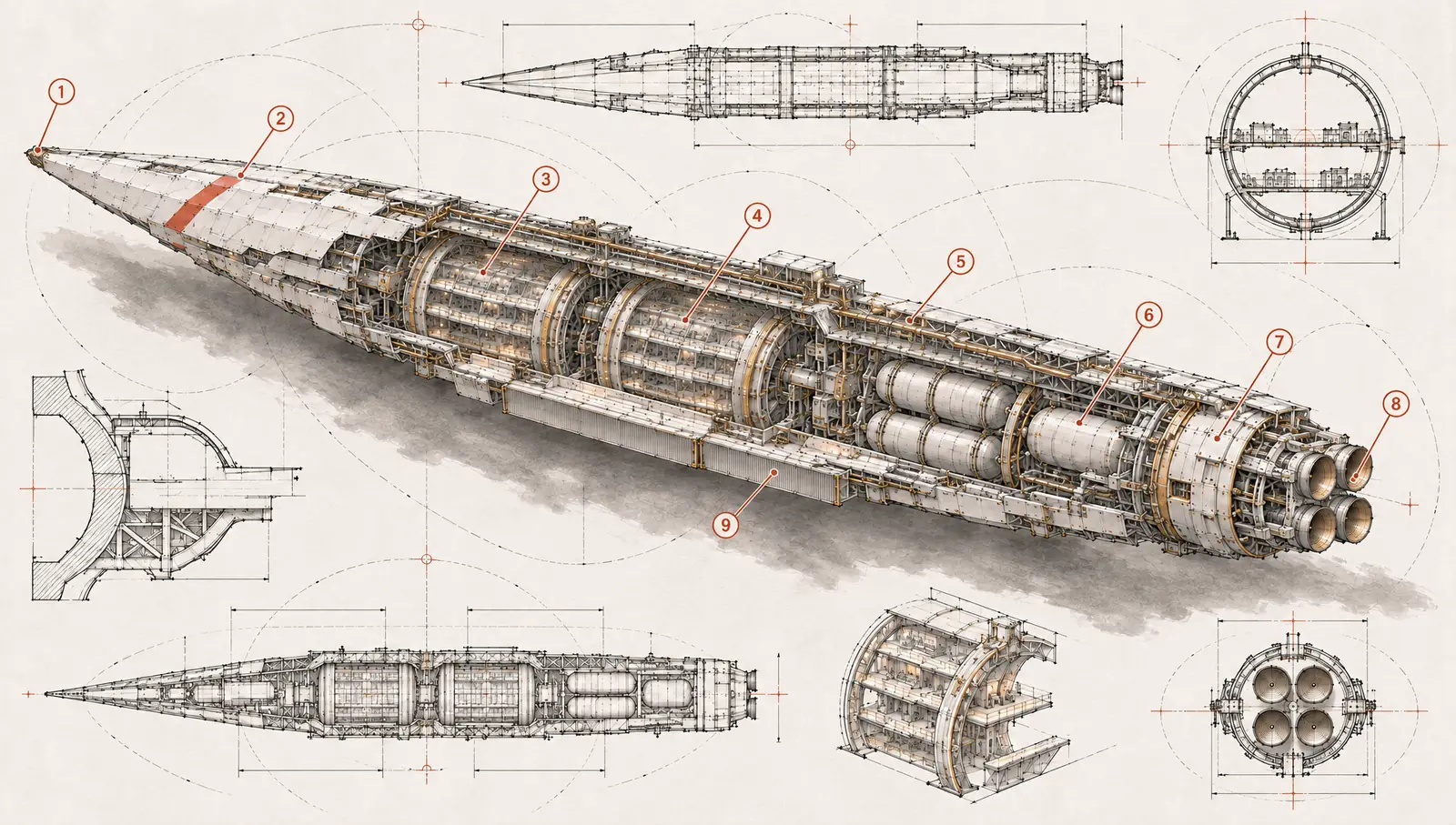
The ship船
The hull in the yard, finished, as its engineers draw it. Nobody outside knows what it is for, or where it is meant to go. From a distance you can see a long blade of a hull with a red stripe behind the bow. The rest is theirs.
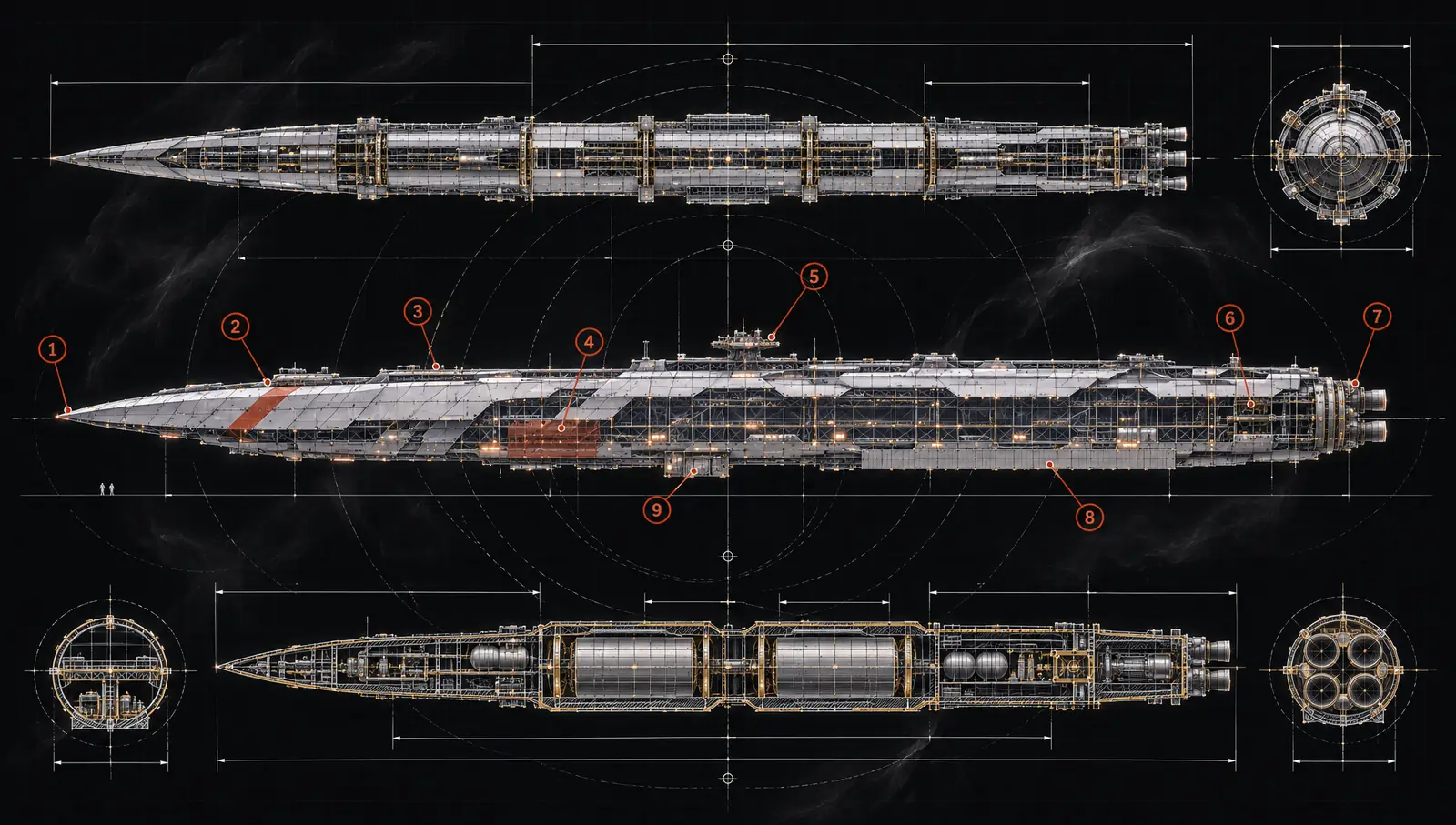
- Bow and dock艦首 The point of the blade, with a docking port in the tip.
- The stripe識別帯 Vermilion, just behind the bow, as it is painted in the yard.
- Ribs and plating肋材と外板 White plates over a frame of rings.
- Habitat section居住区 Two drums inside, spinning opposite ways for weight.
- Mast通信マスト Antennas for the long talk home.
- Shield bulkhead遮蔽隔壁 Everything forward of it stays in the reactor's shadow.
- Engines推進器 Four electric thrusters: a faint push that never stops.
- Radiators放熱板 Folded flat along the flank; a reactor's heat can only leave as light.
- Flank dock側面ドック Where crew and cargo come aboard.
船名Name withheld
目的地Destination withheld
The ship, cut open
等角図
A ship for the Solar System, the same hull that lies in the cradle in the yard. No warp drive and no artificial gravity: drums that spin inside the hull for weight, a reactor behind a shield, and engines that push gently for months.
- Bow艦首 The point of the blade.
- The stripe識別帯 Vermilion, as in the yard.
- Fore drum前部居住ドラム Spins for weight; its decks run its whole length.
- Aft drum後部居住ドラム Spins the other way, so the ship doesn't turn.
- Spine主配管 Cables and pipes from bow to stern.
- Propellant tanks推進剤タンク Long tanks inside the hull.
- Shield and reactor遮蔽と原子炉 Power for the engines, behind its shield.
- Engines推進器 Four bells at the stern.
- Radiators放熱板 Folded flat along the flank.
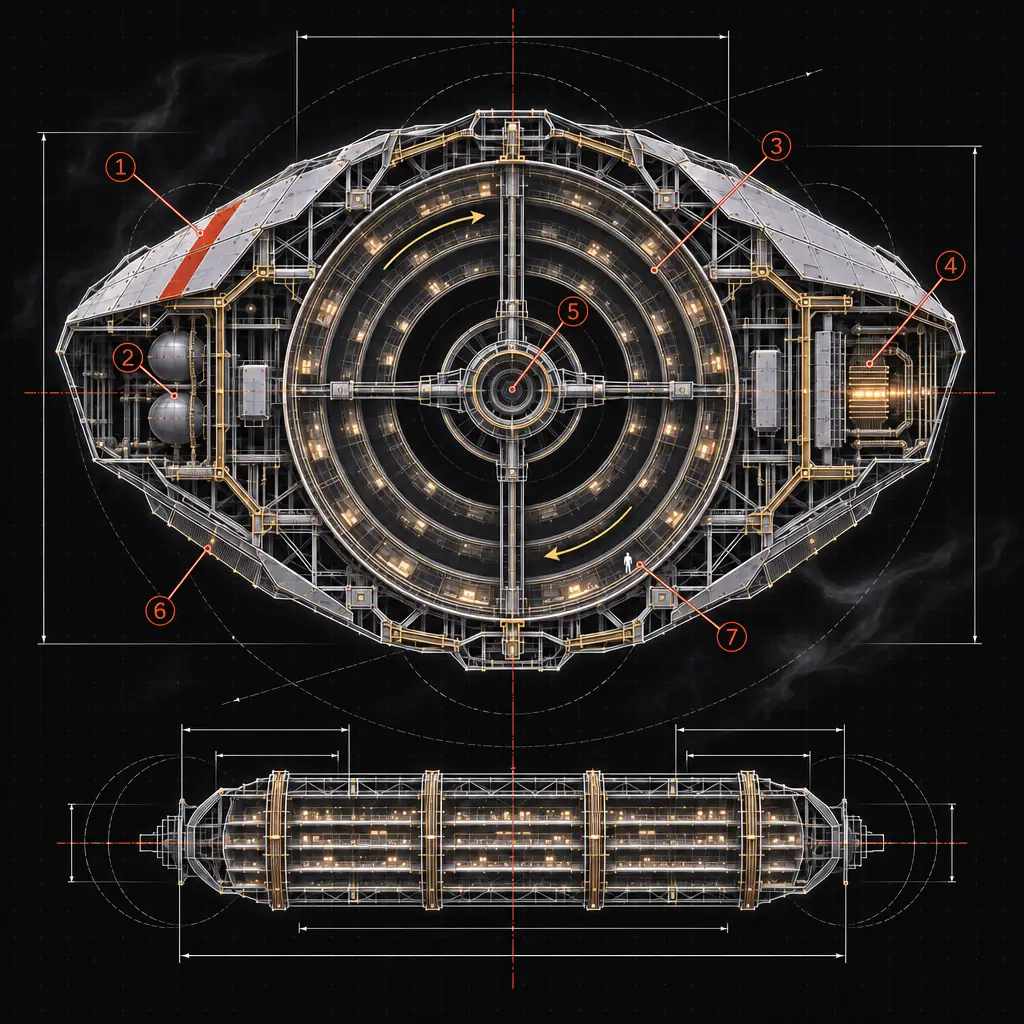
The hull in section
断面図
A ship for the Solar System, the same hull that lies in the cradle in the yard. No warp drive and no artificial gravity: drums that spin inside the hull for weight, a reactor behind a shield, and engines that push gently for months.
- Outer hull外板 Faceted plates, with the vermilion stripe.
- Tanksタンク Water and air, close to the crew.
- Decksデッキ Arcs round the axle: down points outward.
- Power and air生命維持 Machinery between drum and hull.
- Axle回転軸 The still centre; almost no weight here.
- Rib frame肋材 The rings the plates hang on.
- A person人 For scale, standing on the outermost deck.
The ship
船
A ship for the Solar System, the same hull that lies in the cradle in the yard. No warp drive and no artificial gravity: drums that spin inside the hull for weight, a reactor behind a shield, and engines that push gently for months.
Name withheld
Destination withheld
- Bow and dock艦首 The point of the blade, with a docking port in the tip.
- The stripe識別帯 Vermilion, just behind the bow, as it is painted in the yard.
- Ribs and plating肋材と外板 White plates over a frame of rings.
- Habitat section居住区 Two drums inside, spinning opposite ways for weight.
- Mast通信マスト Antennas for the long talk home.
- Shield bulkhead遮蔽隔壁 Everything forward of it stays in the reactor's shadow.
- Engines推進器 Four electric thrusters: a faint push that never stops.
- Radiators放熱板 Folded flat along the flank; a reactor's heat can only leave as light.
- Flank dock側面ドック Where crew and cargo come aboard.
The instruments観測機器
How the Outcasts measure the sky: the instruments astronomers use today, built a few steps further.
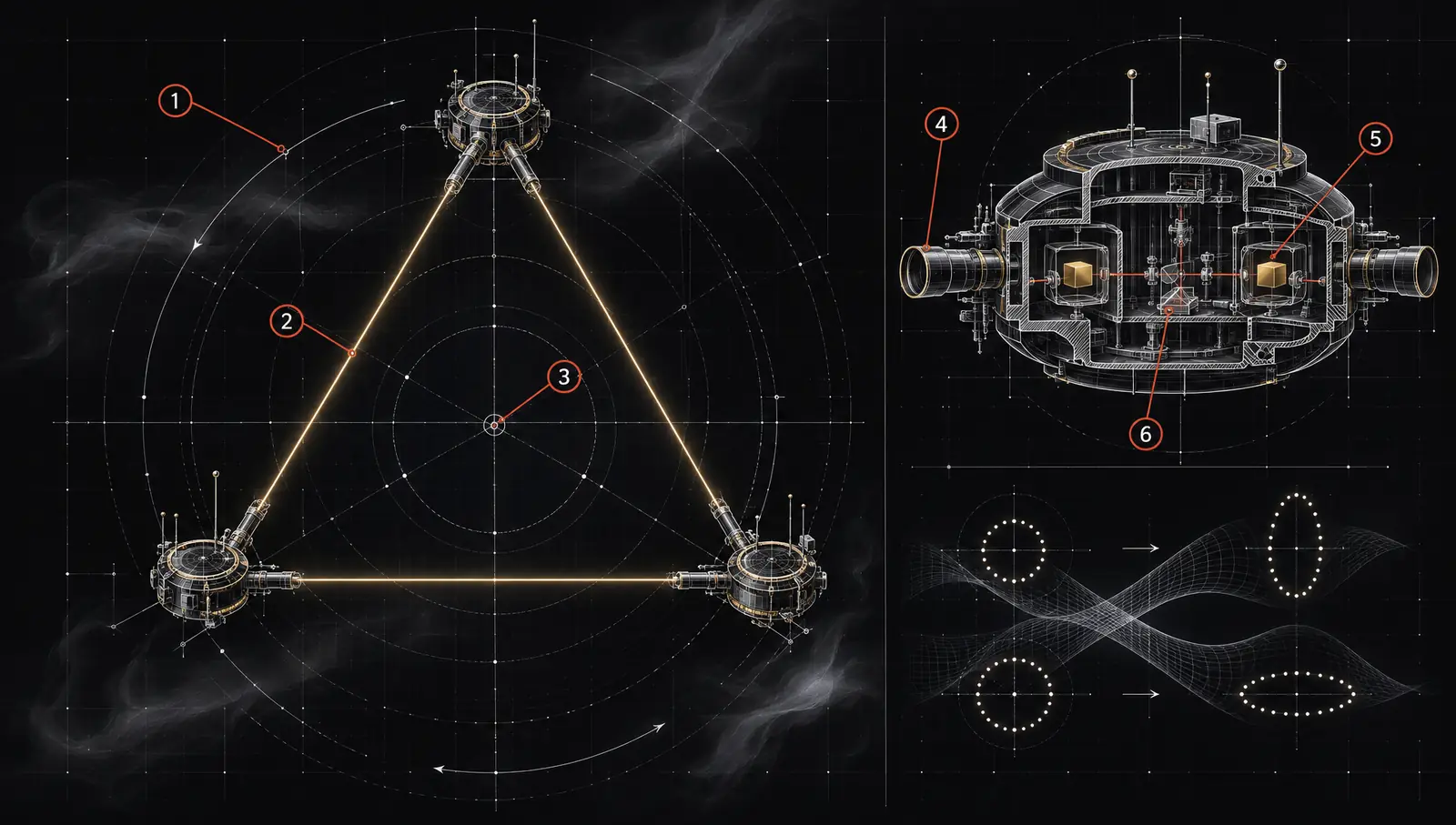
Three craft fly in a triangle millions of kilometres across, joined by laser light. When a gravitational wave passes, one arm stretches and another squeezes by far less than the width of an atom, and the lasers notice.
Today · Laser interferometers on the ground already hear black holes collide; a three-craft version in space is planned.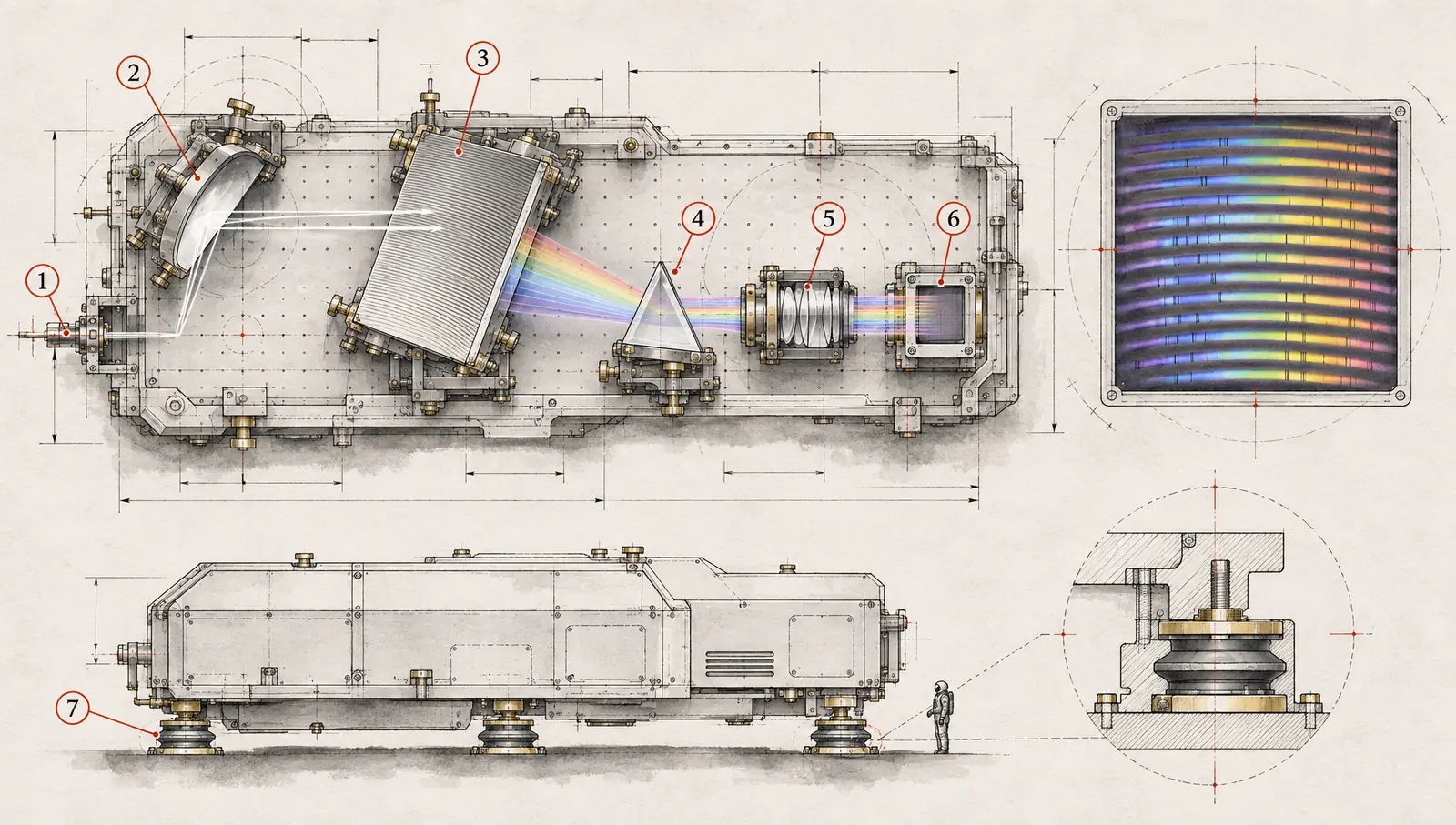
It splits starlight into thousands of colours. The thin dark lines in them say what a star is made of, and how fast it is moving towards us or away.
Today · Spectrographs like this find planets by the tiny wobble they give their star.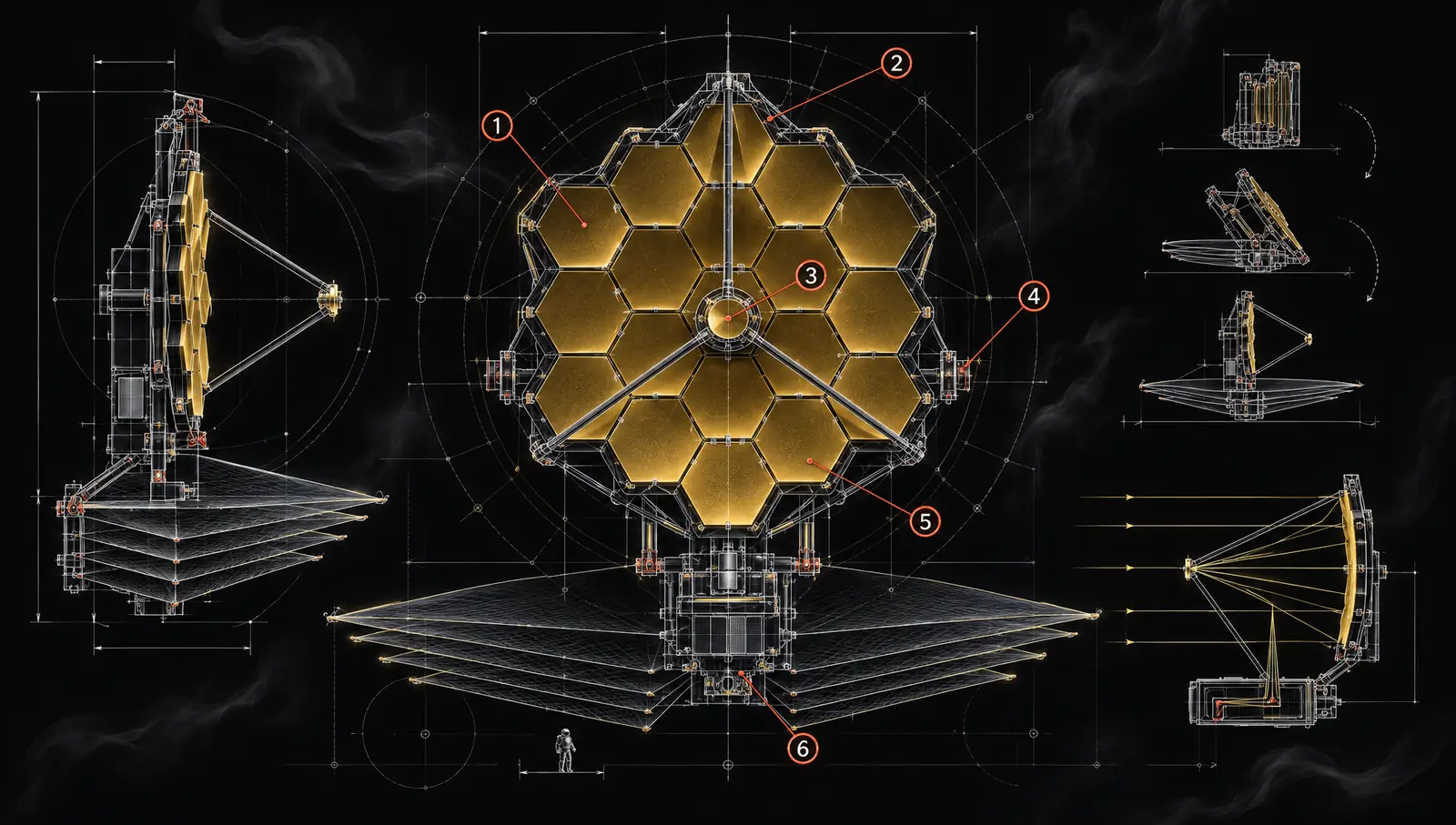
A mirror too big for any rocket, so it flies folded and opens in space: hexagons of gold-coated beryllium behind a sunshield the size of a court.
Today · The largest telescope in space today has eighteen segments and five sunshield layers.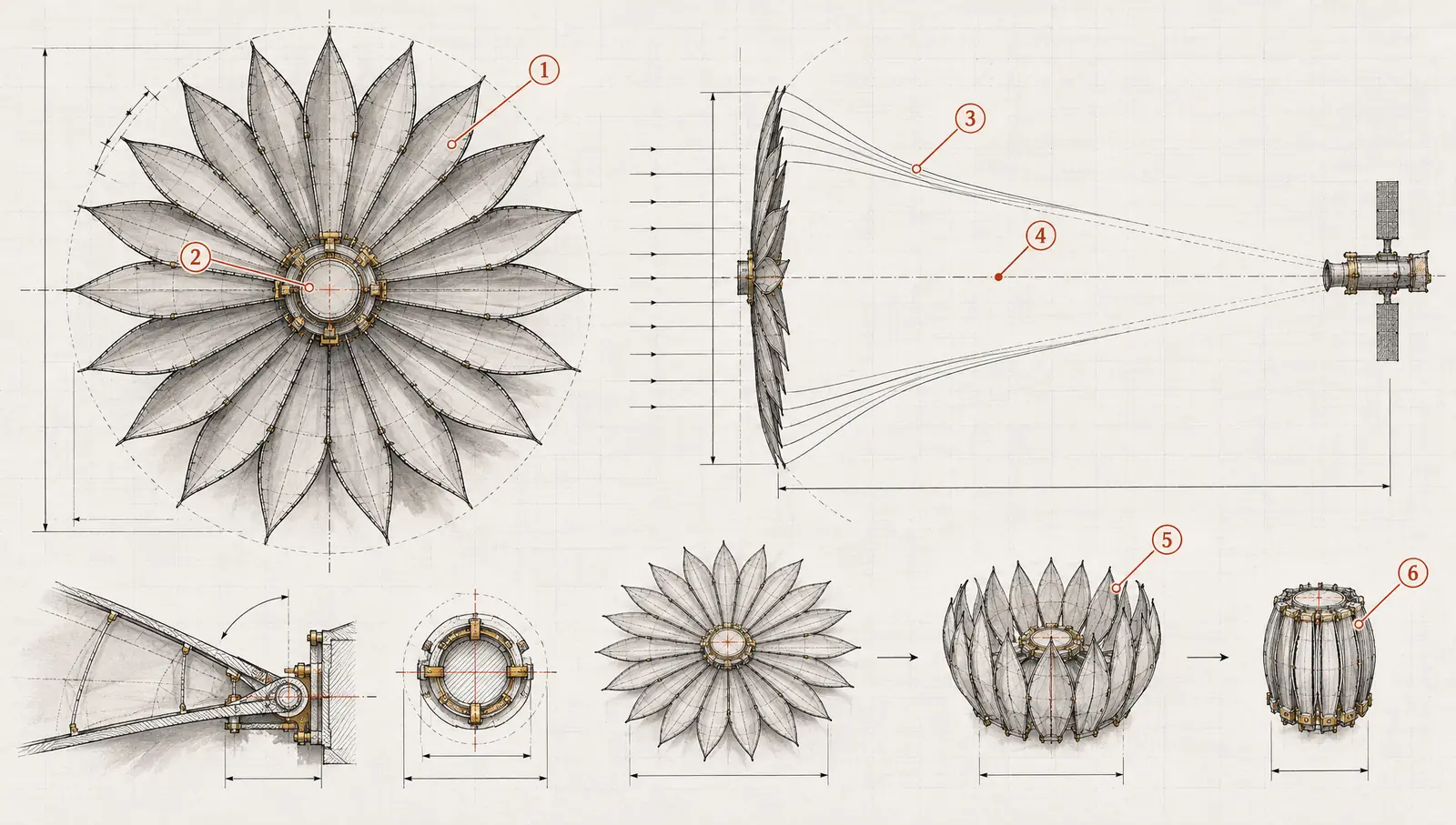
A giant flower that flies tens of thousands of kilometres in front of a telescope. Its petals are shaped so the starlight cancels itself out in the shadow, and the faint planets beside the star come into view.
Today · Starshades are being designed and tested at small scale for future planet-hunting telescopes.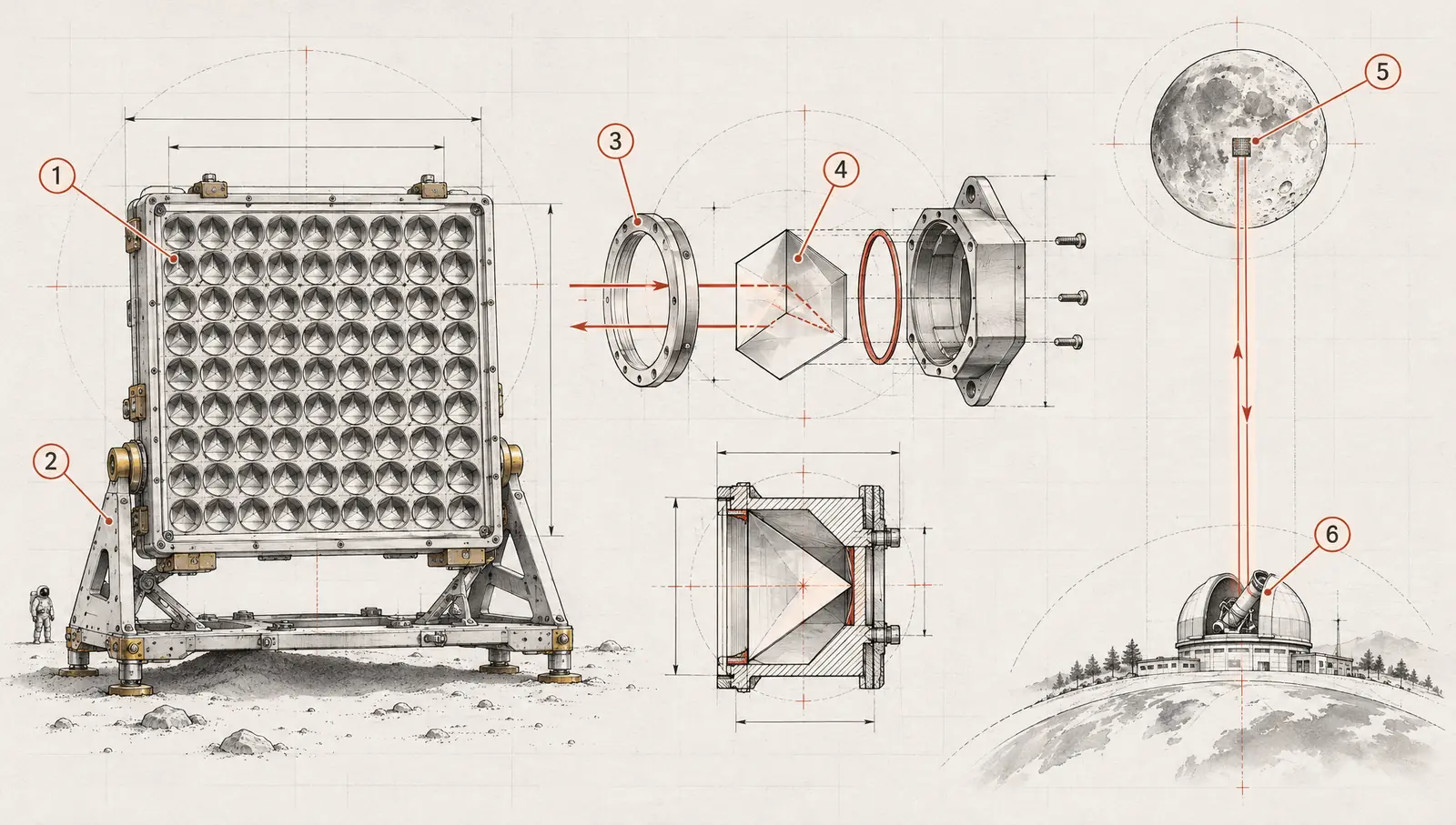
Corner-cube mirrors on the Moon send a laser pulse straight back where it came from. Time the round trip and you know the distance to the Moon to within millimetres.
Today · Reflectors like these, left on the Moon, show it drifting away from Earth by about 3.8 centimetres a year.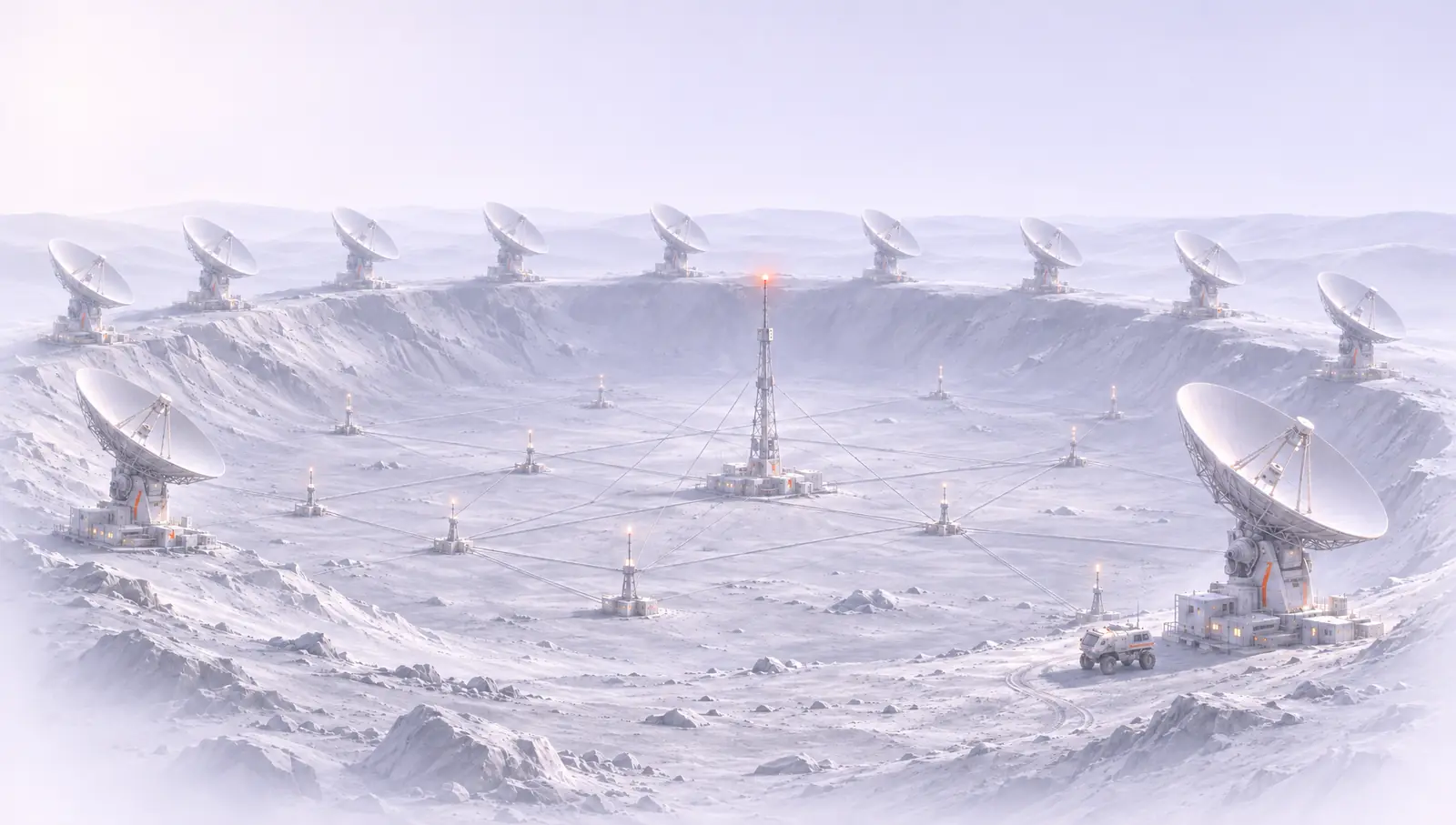
On the far side of the Moon the whole Moon stands between you and Earth's radio noise. It is the quietest place near us to listen to the early universe.
Today · Radio arrays for the lunar far side are being studied; the first small receivers have flown.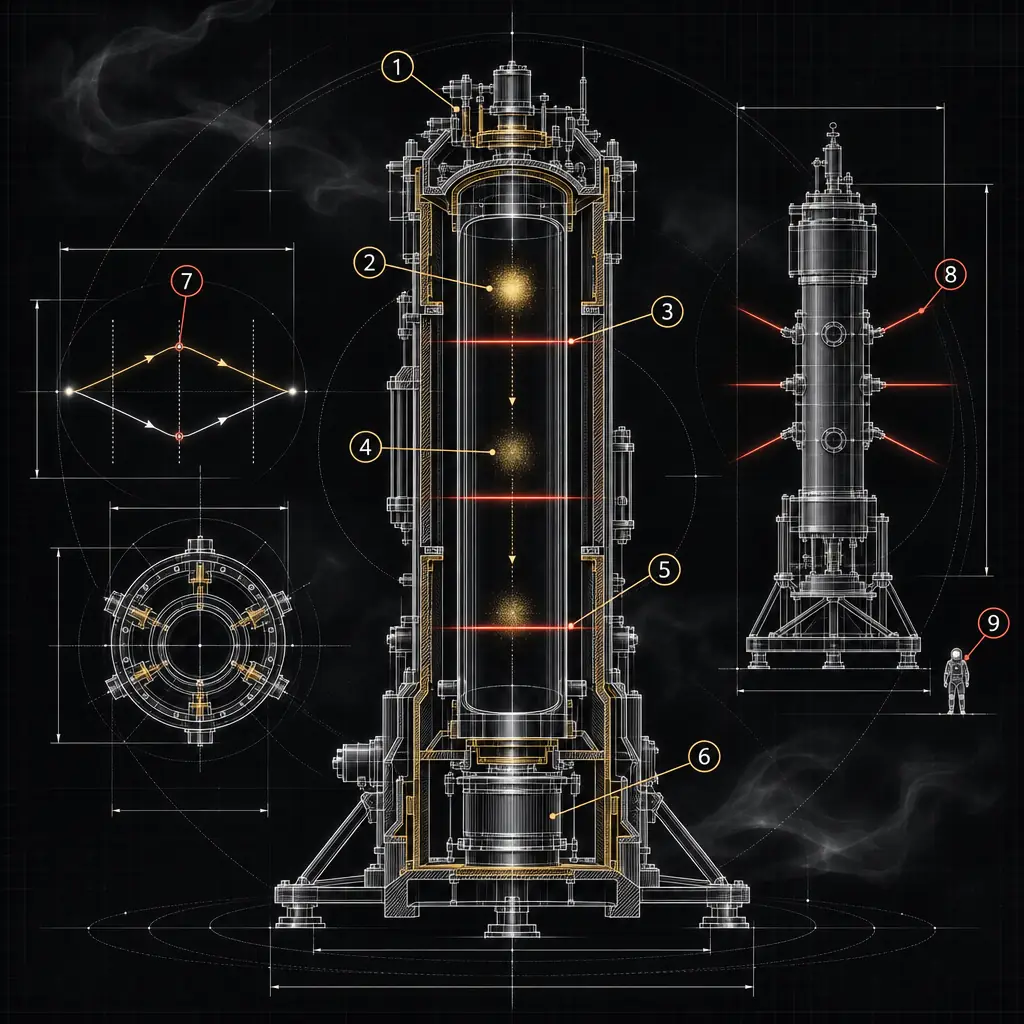
Drop a cloud of atoms cooled to almost absolute zero, split each atom into two paths with laser light, and bring them back together. How they meet tells you the pull of gravity, to parts in a billion.
Today · Atom gravimeters already map what lies under the ground, from water to hidden caves.The long-arm interferometer
重力波干渉計
Three craft fly in a triangle millions of kilometres across, joined by laser light. When a gravitational wave passes, one arm stretches and another squeezes by far less than the width of an atom, and the lasers notice.
Today · Laser interferometers on the ground already hear black holes collide; a three-craft version in space is planned.
- The slow turn回転 The triangle turns round its own centre as it orbits.
- Laser arm腕 Millions of kilometres of light between two craft.
- Centre中心 The point the triangle turns round.
- Telescope望遠鏡 Each craft sends and receives along two arms.
- Test mass試験質量 A small gold-platinum cube floating free; nothing touches it.
- Optical bench光学台 Where the beams are compared.
The echelle spectrograph
エシェル分光器
It splits starlight into thousands of colours. The thin dark lines in them say what a star is made of, and how fast it is moving towards us or away.
Today · Spectrographs like this find planets by the tiny wobble they give their star.
- Slitスリット Lets in a thin line of starlight.
- Collimating mirrorコリメーター鏡 Makes the light parallel.
- Echelle gratingエシェル回折格子 Thousands of fine grooves that spread the colours.
- Prismプリズム Splits the overlapping orders apart.
- Cameraカメラ Focuses the spectrum.
- Detector検出器 Records the stacked bands of colour.
- Vibration mount防振台 Keeps the whole bench still.
The segmented mirror
分割鏡望遠鏡
A mirror too big for any rocket, so it flies folded and opens in space: hexagons of gold-coated beryllium behind a sunshield the size of a court.
Today · The largest telescope in space today has eighteen segments and five sunshield layers.
- Mirror segment鏡片 One of eighteen gold-coated hexagons.
- Strut支柱 Holds the small mirror in front.
- Secondary mirror副鏡 Sends the light back through the centre.
- Wing hingeヒンジ The outer segments fold back for launch.
- Primary mirror主鏡 All segments together act as one.
- Instrument bay観測装置 Where the cameras sit, in the cold.
The starshade
スターシェード
A giant flower that flies tens of thousands of kilometres in front of a telescope. Its petals are shaped so the starlight cancels itself out in the shadow, and the faint planets beside the star come into view.
Today · Starshades are being designed and tested at small scale for future planet-hunting telescopes.
- Petal花弁 Each edge is cut to a precise curve.
- Hub中心部 The petals fold round it.
- Bent starlight回折光 Light bends round the tips and misses the telescope.
- Line of sight視線 The telescope sits in the darkest part of the shadow.
- Unfolding展開 The petals open like a flower.
- Stowed収納 Folded tight for launch.
The ranging mirror
再帰反射鏡
Corner-cube mirrors on the Moon send a laser pulse straight back where it came from. Time the round trip and you know the distance to the Moon to within millimetres.
Today · Reflectors like these, left on the Moon, show it drifting away from Earth by about 3.8 centimetres a year.
- Reflector array反射鏡アレイ A hundred corner cubes in one frame.
- Stand架台 Tilted to face the Earth.
- Retaining ring保持リング Holds each prism in its cup.
- Corner cubeコーナーキューブ Three mirror faces at right angles send light straight back.
- On the Moon月面 The panel, far away.
- The telescope望遠鏡 Fires the pulse and catches the few photons that return.
The far-side array
月裏側電波望遠鏡群
On the far side of the Moon the whole Moon stands between you and Earth's radio noise. It is the quietest place near us to listen to the early universe.
Today · Radio arrays for the lunar far side are being studied; the first small receivers have flown.
- Dish ringパラボラ A dozen dishes round the crater rim, all pointing the same way.
- Wire webアンテナ網 Fine antennas strung across the crater floor.
- Central mast中央マスト With the one vermilion beacon.
- Rover探査車 For the crew who keep it running.
The atom gravimeter
原子干渉重力計
Drop a cloud of atoms cooled to almost absolute zero, split each atom into two paths with laser light, and bring them back together. How they meet tells you the pull of gravity, to parts in a billion.
Today · Atom gravimeters already map what lies under the ground, from water to hidden caves.
- Vacuum head真空部 Keeps the tube empty.
- Atom cloud原子雲 Cooled almost to absolute zero, then let fall.
- First pulse第一パルス Splits each atom into two paths.
- Falling cloud落下 Falls freely down the tube.
- Last pulse最終パルス Brings the two paths together again.
- Detector and base検出器 Counts where the atoms ended up; the base damps vibration.
- The two paths経路 Apart, then together: a diamond.
- Cooling lasers冷却レーザー Six beams slow the atoms down.
- Scale縮尺 A person, for size.